

If you've been agonizing over what is resume length for ATS, you're not alone. Most job seekers assume that a longer resume means more keywords, and more keywords means a better shot at getting through. That logic sounds reasonable. It's also wrong. ATS systems don't reward volume. They reward relevance, formatting, and precision. Understanding how these systems actually evaluate your resume is the difference between getting filtered out before a human ever reads your name and landing an interview.
Table of Contents
- Key takeaways
- What is resume length for ATS and why it matters
- Resume length guidelines by career stage
- Common myths about ATS resume length
- Practical tips for an ATS-friendly resume
- My take on ATS resume length advice
- Get your resume ATS-ready with Parseworks
- FAQ
Key takeaways
| Point | Details |
|---|---|
| ATS prioritizes relevance over length | Systems rank candidates by keyword match and formatting quality, not page count. |
| Career stage determines ideal length | Entry-level resumes work best at one page; mid-career professionals benefit from two. |
| Padding hurts your ranking | Adding filler content dilutes keyword density and weakens your ATS score. |
| Clean formatting is non-negotiable | Complex tables, columns, and graphics cause parsing errors regardless of resume length. |
| 8 to 20 keywords is the sweet spot | Naturally incorporating the right number of keywords improves ATS passage without triggering penalties. |
What is resume length for ATS and why it matters
The short answer: ATS systems don't measure your resume in pages. They measure it in relevance. When your resume enters an applicant tracking system, the software parses the text, extracts keywords, and scores your application against the job description. Page count is not part of that calculation.
What does matter is whether your resume contains the right terms in the right context. Up to 75% of resumes are rejected by ATS before a human ever sees them, and the primary culprits are poor formatting and keyword misalignment. Not length.
Here's where the confusion starts. Many job seekers assume that a longer resume gives them more real estate to pack in keywords. In theory, that sounds smart. In practice, it backfires. Padding your resume with loosely relevant content dilutes the keyword density of your strongest material. A focused two-page resume with tight, relevant bullet points will consistently outperform a bloated three-pager stuffed with generic responsibilities.
The other critical factor is formatting. ATS parsers best process single-column plain text documents with clear headers. The moment you introduce multi-column layouts, embedded tables, or graphics, you risk the parser skipping entire sections. Your resume could be two pages of genuinely strong content, and the ATS might only read half of it because of a formatting choice.
Here's what ATS systems actually evaluate:
- Keyword match: How closely your language mirrors the job description
- Formatting structure: Whether the parser can extract your information cleanly
- Section clarity: Whether standard headers like "Work Experience" and "Education" are present and readable
- Contextual relevance: Whether keywords appear in meaningful sentences, not just lists
Pro Tip: Run a side-by-side comparison of your resume and the job description. If you can't spot at least five to eight matching phrases in your top half, your keyword alignment needs work before you worry about length.
Resume length guidelines by career stage
This is where the ideal ATS resume length question gets practical. There is no single correct answer, but there are strong benchmarks based on career stage and industry.
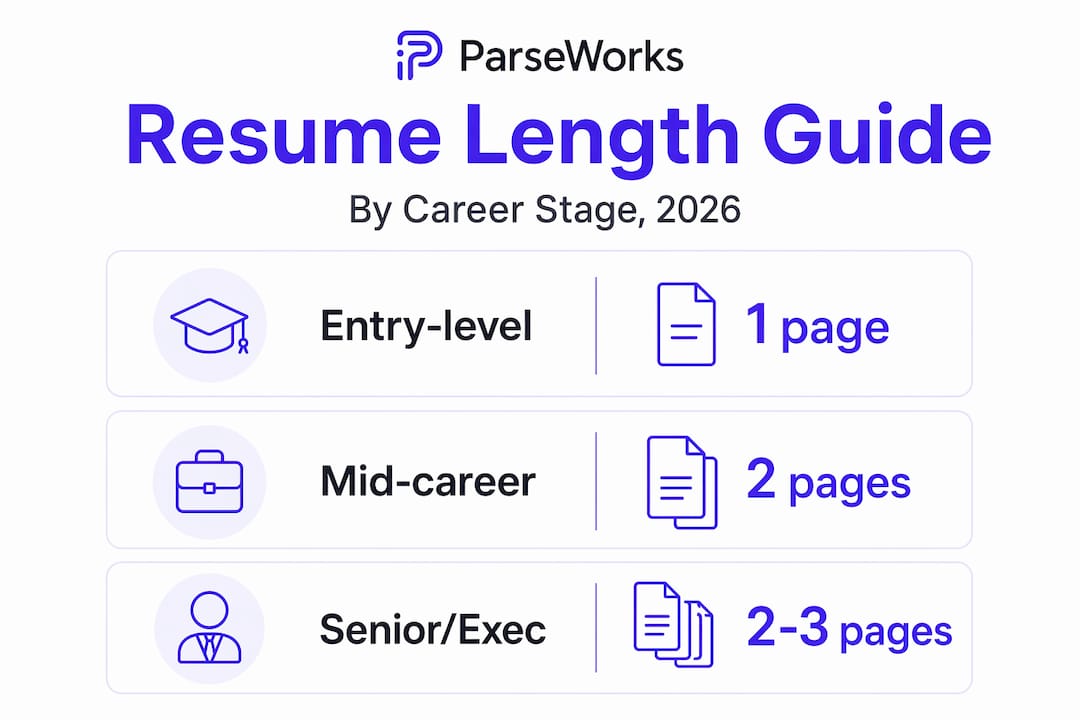
| Career Stage | Recommended Length | Approximate Word Count |
|---|---|---|
| Entry-level (0 to 3 years) | One page | 400 to 500 words |
| Mid-career (4 to 10 years) | One to two pages | 500 to 800 words |
| Senior or executive (10+ years) | Two to three pages | 800 to 1,200 words |
| Academic or research roles | CV format (no strict limit) | 1,000+ words |
For entry-level candidates, one page is still the right call. Not because ATS prefers it, but because you simply don't have enough relevant experience to justify more space. Padding to fill a second page with coursework and unrelated jobs creates noise, not signal.
Mid-career professionals are where the two-page resume earns its reputation. Approximately 68% of HR professionals prefer two-page resumes when the content is relevant, and well-crafted two-pagers can deliver nearly three times the interview lift over one-pagers. That's a meaningful difference. The key phrase is "when the content is relevant." Two pages of tight accomplishment statements, quantified results, and role-specific keywords will outperform one page of vague responsibilities every time.

Senior-level candidates and executives often need two to three pages to do their experience justice. Recruiters favor two-page resumes for managerial and senior roles specifically because detailed accomplishment documentation matters at that level. If you're a VP with 20 years of experience, trying to compress everything into one page isn't discipline. It's self-sabotage.
Industry also plays a real role. Technology and finance roles tend to reward specificity, which means more room for technical skills, tools, and metrics. Healthcare resumes often include certifications and clinical rotations that naturally extend length. Creative fields sometimes lean shorter because portfolios carry the weight.
Pro Tip: Ask yourself this question for every line on your resume: "Does this directly support my application for this specific role?" If the answer is no, cut it. Length should be a byproduct of relevant content, not a goal in itself.
Common myths about ATS resume length
The biggest myth in circulation is that ATS systems prefer longer resumes because more text means more keyword opportunities. Modern ATS rank candidates by relevance, not document length. Padding a resume to increase keyword count actually works against you by lowering the ratio of relevant content to total content.
The second myth is keyword stuffing. Some candidates repeat the same terms five or six times hoping the ATS picks them up more frequently. This is a misunderstanding of how scoring works. ATS systems are looking for contextual use of keywords across different sections, not repetition in the same paragraph. Stuffing also creates a document that reads as incoherent to the human recruiter who sees it after the ATS passes it through.
"The traditional single-page resume guideline is fading. The real advantage lies in relevance and keyword density, not length." — DEV Community, 2026
The third myth is that complex formatting signals professionalism. Candidates often spend hours designing multi-column resumes with icons, color-coded sections, and sidebar skill bars. Poor formatting choices like unusual fonts, graphics, and columns lead to ATS parsing errors that can cause outright rejection. The recruiter never sees the beautiful design. The ATS just sees broken text.
Here's what actually hurts your ATS ranking:
- Adding a summary paragraph that restates your job title five times
- Using a two-column layout where the ATS reads columns left to right across both, creating gibberish
- Including a "Skills" section that lists 40 tools with no context
- Padding work history with responsibilities that don't match the job description
- Using headers like "About Me" or "My Story" instead of standard labels the ATS recognizes
Practical tips for an ATS-friendly resume
Getting the best resume length for ATS right is only half the equation. How you structure and write that content determines whether the ATS actually reads it correctly.
-
Use a single-column layout. Many ATS parsers struggle with complex formatting including tables and columns, leading to content omissions. A clean, left-aligned single-column format is the most reliable choice.
-
Mirror the job description language. Candidates who mirror exact job description terminology rank higher in modern ATS. If the posting says "cross-functional collaboration," use that phrase. Don't substitute "worked with multiple teams."
-
Target 8 to 20 core keywords. Incorporating 8 to 20 keywords naturally and varying their context improves ATS passage without triggering penalties. Use the job description as your primary source.
-
Write quantified bullet points. Replace "managed a team" with "managed a team of 12 engineers across three product launches, reducing time-to-deploy by 30%." Specificity signals competence to both the ATS and the recruiter.
-
Use standard section headers. Stick to "Work Experience," "Education," "Skills," and "Certifications." Creative alternatives confuse parsers.
-
Choose the right file format. Submit .docx files unless the application explicitly requests PDF. Many ATS platforms parse Word documents more reliably.
-
Test before you submit. Run your resume through an ATS parsing tool to see exactly what the system extracts. What you see in your formatted document and what the ATS reads are often very different things.
Pro Tip: Copy your resume text into a plain text editor and read it. If it makes sense, your ATS parsing will likely be clean. If it looks scrambled, your formatting is causing problems.
My take on ATS resume length advice
I've reviewed hundreds of resumes over the years, and the single most damaging piece of advice still circulating is the strict one-page rule. In 2026, that rule is not just outdated. It actively hurts mid-career and senior candidates who compress 15 years of accomplishments into a single page and end up with a document that's too thin on keywords to rank well.
What I see far more often than resumes that are too long are resumes that are too vague. Candidates write "responsible for project management" when they mean "led a $2M infrastructure migration delivered three weeks ahead of schedule." The vague version takes up the same space and scores far lower.
The other mistake I keep seeing is candidates treating ATS as an obstacle to game rather than a system to communicate with clearly. When you understand that ATS systems scan primarily for keywords, formatting, and structure, the entire strategy shifts. You stop asking "how long should my resume be?" and start asking "does every line on this resume earn its place?"
That shift in thinking produces better results than any length rule ever will. Focus on relevance. Keep your formatting clean. Match the language of the role you want. The right length will follow naturally from that discipline.
— Sam
Get your resume ATS-ready with Parseworks
Knowing the resume length guidelines for ATS is one thing. Seeing exactly how your resume performs inside a real parser is another.
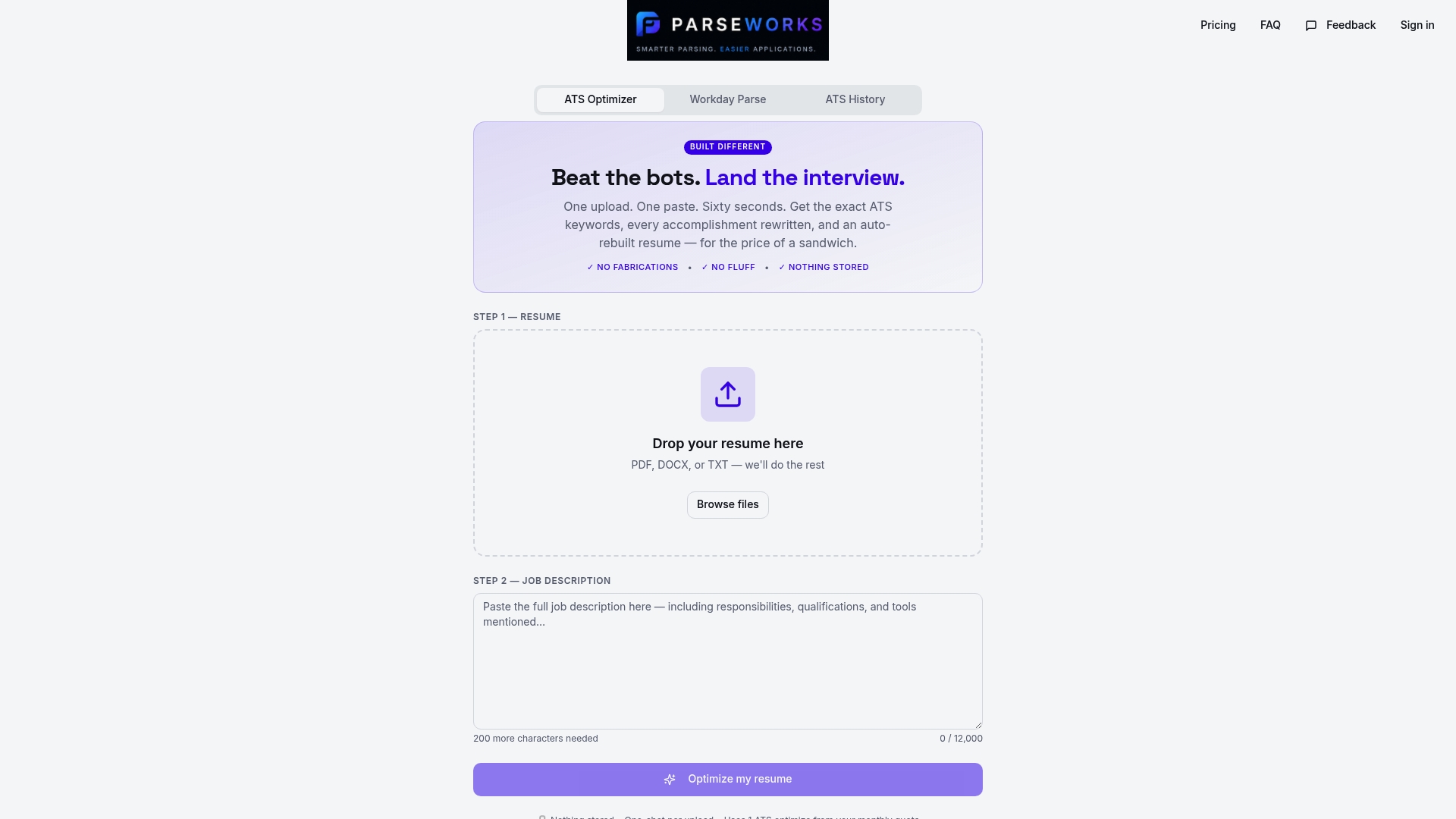
Parseworks is built for exactly this problem. It parses your resume the same way ATS platforms like Workday do, shows you what's being read and what's being missed, and flags keyword gaps against the job description you're targeting. You get a resume readiness score, rewritten bullet suggestions, and formatting feedback, all without spending an hour copy-pasting into broken application portals. If you're ready to stop guessing and start applying with confidence, check out Parseworks pricing to find the plan that fits your search.
FAQ
What is the ideal ATS resume length?
For most professionals, one to two pages is the ideal ATS resume length. Entry-level candidates should stay at one page, while mid-career and senior professionals benefit from two pages when content is fully relevant to the target role.
Does a longer resume rank better in ATS?
No. ATS systems rank candidates by keyword relevance and formatting quality, not page count. Padding a resume with irrelevant content dilutes keyword density and can lower your overall ATS score.
How many keywords should I include for ATS?
Incorporating 8 to 20 core keywords naturally across your resume is the recommended range. Use the job description as your guide and vary the context in which keywords appear rather than repeating the same terms.
What file format works best for ATS?
A .docx file is generally the safest choice for ATS compatibility. Some systems parse PDF files well, but .docx format tends to produce the most reliable keyword extraction across different platforms.
Why does formatting affect ATS resume length recommendations?
Because a poorly formatted resume can prevent the ATS from reading entire sections, effectively shortening the content the system evaluates. A two-page resume with a multi-column layout may only have half its content parsed, making clean single-column formatting as important as the length itself.