

If you've ever posted the same job listing to six different platforms manually, you already know the pain. Understanding how job boards use ATS is the difference between a fragmented, error-prone hiring process and one that actually scales. Nearly 99% of Fortune 500 companies now rely on applicant tracking systems, and the way those systems connect to job boards has become the operational backbone of modern recruiting. This article breaks down exactly how that connection works, where it helps, where it breaks, and what smart recruiters do about it.
Table of Contents
- Key takeaways
- How job boards use ATS: the core technology
- Benefits of ATS integration for recruiting teams
- Challenges and nuances in ATS integrations
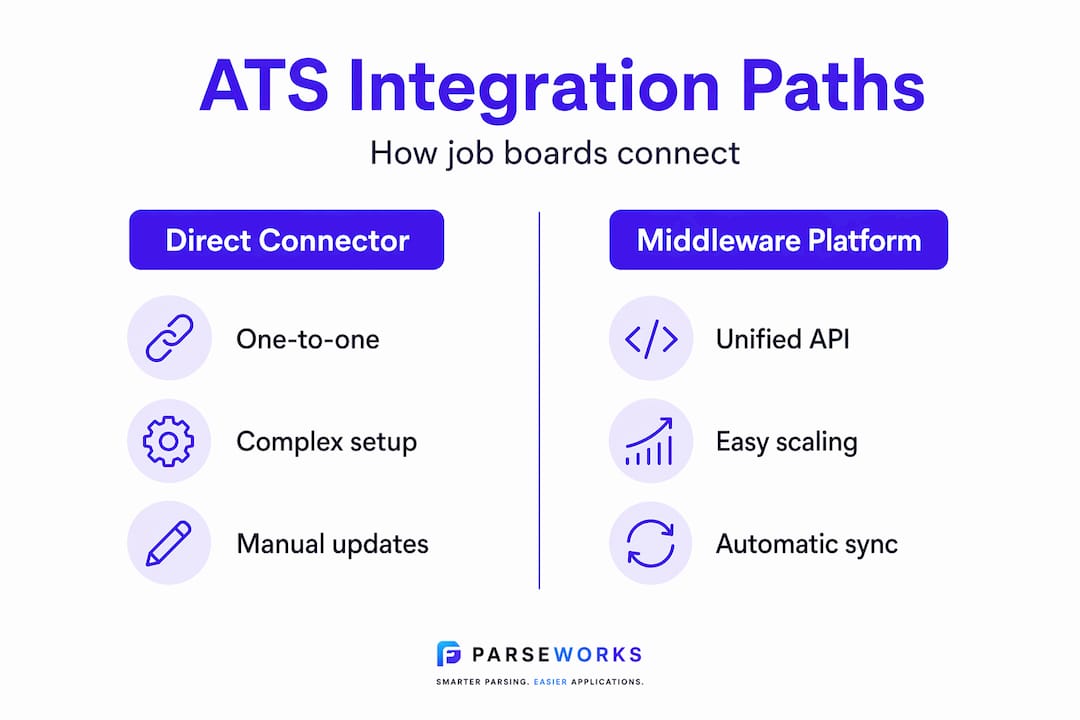
- Direct connectors vs. unified middleware platforms
- Practical steps to maximize ATS and job board performance
- My take on where ATS-job board integration actually breaks down
- How Parseworks helps recruiters get more from ATS
- FAQ
Key takeaways
| Point | Details |
|---|---|
| ATS drives job distribution | Modern ATS platforms push job listings to thousands of boards from a single posting interface. |
| APIs power synchronization | REST APIs and webhook events keep job data accurate and current across all connected platforms. |
| Organic visibility is at stake | Since March 2026, Indeed requires ATS integration to maintain free organic search placement. |
| Middleware reduces complexity | Unified API platforms connect ATS vendors to 25,000+ job sites through a single integration point. |
| Resume parsing quality matters | Formatting issues in candidate resumes can corrupt ATS data and affect how recruiters find applicants. |
How job boards use ATS: the core technology
At its most basic level, a job board and an ATS need to talk to each other. The question is how.
When a recruiter creates a job requisition inside an ATS, that record contains structured data: job title, location, department, description, required skills, salary range, and application URL. That structured data doesn't get copy-pasted into each job board manually. Instead, it gets transmitted programmatically.
Here's what that looks like in practice:
- REST APIs with JSON payloads: ATS platforms expose REST APIs that accept and send structured JSON payloads. When a job is created or updated, the ATS sends that JSON to connected job boards, which then parse and display the listing. This isn't a file upload. It's a live data exchange.
- Webhook events for real-time sync: When a job closes, gets edited, or is paused, the ATS fires a webhook event. Connected job boards receive that signal and update their display automatically. No manual intervention needed.
- Data normalization: Different ATS platforms use different field names and formats. Job boards solve this by normalizing incoming data so a "location" field from one ATS maps correctly regardless of what the originating system calls it. Unified API platforms standardize these fields across 73 or more ATS providers, which matters enormously for display accuracy.
- Application routing: When a candidate applies on the job board, the ATS receives that application back through the same API channel. The candidate record gets created inside the ATS without the recruiter touching anything.
- Multi-board distribution from one source: Rather than a recruiter logging into Indeed, LinkedIn, and 15 niche boards separately, the ATS acts as the single source of record and broadcasts outward.
This architecture is why job board features and ATS capabilities are increasingly inseparable. The board is effectively a display and intake layer. The ATS is the system of record.
Benefits of ATS integration for recruiting teams
The operational advantages here are real and significant, not theoretical.
Centralized control is the most immediate gain. A recruiter managing five open roles across eight boards used to mean 40 separate logins, 40 separate updates when the job description changed, and 40 opportunities to introduce inconsistency. With ATS integration, that becomes one update in one system that propagates everywhere automatically.
Organic visibility on major platforms is now tied directly to ATS compliance. Since March 31, 2026, manual job postings lose free organic placement on Indeed. Employers who rely on copy-paste posting are now paying for visibility that ATS-integrated employers get for free. That's a direct cost of not integrating.
AI-powered sourcing and scheduling multiplies the impact further. AI-integrated ATS platforms save recruiters an average of 12 hours per week by unifying sourcing, outreach, and interview scheduling in one pipeline. When your job boards feed directly into that pipeline, the entire funnel accelerates.
Other concrete benefits include:
- Fewer data entry errors since job details are populated once and distributed automatically
- Faster candidate flow because applications arrive in the ATS in real time rather than through manual imports
- Consistent job branding across every board since all listings originate from the same source record
- Easier compliance tracking since every application is timestamped and stored centrally
Pro Tip: Set up automated alerts inside your ATS for any posting that stops receiving applications after 48 hours. This often signals a broken integration or a data formatting issue before it becomes a sourcing gap.
Challenges and nuances in ATS integrations
Anyone who has worked inside a large recruiting operation knows that integrations break. Understanding where and why is what separates teams that recover quickly from those that don't.

Technical maintenance debt is the most persistent issue. Each direct ATS-to-job-board connection is its own relationship to maintain. When a job board updates its API version, changes authentication requirements, or alters its data schema, every ATS vendor with a direct integration must update their connector. Multiply that across dozens of boards and you have an ongoing engineering burden that compounds over time.
Data formatting and parsing failures are common and often invisible. Formatting issues in job or resume data can cause ATS systems to misclassify information, meaning candidates get filed incorrectly or jobs display with corrupted fields. A salary range that doesn't parse correctly might cause the job to disappear from filtered searches entirely.
Platform policy shifts require constant attention. The Indeed 2026 organic visibility change is the clearest recent example. Indeed's policy now deprioritizes manual postings in search results, pushing employers toward ATS-based distribution. Teams that weren't monitoring platform policy changes lost organic traffic before they knew what happened.
"Algorithmic rejections are less common than candidates never being reviewed at all." This finding from research on ATS workflows highlights a less-discussed reality: many recruiters disregard ATS candidate rankings due to concerns about bias and prefer to review candidates manually. That means the automation benefit can be partially undermined by recruiter behavior downstream.
There's also the issue of keeping integrations current with evolving API standards. OAuth token expiration, rate limit changes, and deprecation of older endpoints can silently break a job distribution workflow without triggering any obvious error in the ATS interface.
Direct connectors vs. unified middleware platforms
This is where recruiters and HR leaders often have to make a genuine strategic decision, and the trade-offs are worth understanding clearly.
| Feature | Direct connectors | Unified middleware |
|---|---|---|
| Setup complexity | High per board | Single integration point |
| Boards accessible | Limited to built-in partners | 25,000+ sites via one API |
| Maintenance burden | High, each board separately | Low, maintained by middleware vendor |
| Data standardization | Inconsistent across boards | Normalized at the middleware layer |
| Cost | Often included in ATS license | Additional subscription or per-post fee |
| Recruiter experience | Requires board-specific knowledge | Unified interface, consistent workflow |
Direct integrations make sense when your organization posts primarily to a small set of major platforms and your ATS vendor has already built and maintains those connections. If 90% of your hires come from three boards, the complexity of a middleware layer may not be justified.
Unified middleware platforms become the clear choice when you're distributing to many boards, especially a mix of generalist and niche sites, or when your ATS vendor's native integrations are limited. Middleware platforms like JobTarget allow an ATS provider to build once and reach over 25,000 job sites, removing the ongoing connector maintenance from both the ATS vendor and the recruiter's plate entirely.
The recruiter experience difference is significant. With middleware, posting to a new niche board requires no new technical work. With direct connectors, adding a new board means waiting for your ATS vendor's engineering roadmap.
Pro Tip: When evaluating an ATS, ask specifically whether they use a unified API middleware model for job distribution. A vendor who has built 50 individual connectors carries 50 times the maintenance risk compared to one using a single middleware integration.
Practical steps to maximize ATS and job board performance
Getting the integration set up is step one. Getting real value from it requires ongoing attention to a few specific areas.
- Confirm your ATS supports major board compliance requirements. Indeed Apply and LinkedIn Easy Apply have specific technical requirements for ATS partners. Verify your ATS is a certified partner for the boards driving your applicant volume, not just connected in a generic sense.
- Monitor posting performance by source. Most ATS platforms track where each application originated. Review this data weekly. If a major board drops from 30 applications per posting to 3, something broke in the integration or the job data is not displaying correctly.
- Use webhook-based synchronization. Real-time webhook events outperform scheduled polling for keeping job status current. A job that closes in your ATS should disappear from job boards within minutes, not hours. Stale listings damage employer brand and waste candidate time.
- Mix generalist and niche boards strategically. Broad distribution through generalist boards handles volume. Niche boards, whether trade-specific, location-specific, or role-specific, often deliver higher quality applicants at lower competition. A well-configured ATS integration handles both without additional recruiter effort.
- Audit your job data quality before posting. Bad input produces bad output across every board simultaneously. Standardize your job title conventions, confirm location data is structured correctly, and verify that salary fields meet each board's required format.
Pro Tip: For ATS resume formatting guidance, share updated resources directly with candidates pre-application. Better formatted resumes parse more accurately inside your ATS, which means better search results when you're reviewing the pipeline.
My take on where ATS-job board integration actually breaks down
I've spent a lot of time watching how recruiting teams interact with ATS data, and the single most common problem is not technical. It's behavioral.
Teams invest in ATS integrations, get everything connected, and then quietly stop trusting the output. They don't use the candidate ranking scores. They don't act on the source attribution data. They manually review every application regardless of what the ATS flagged. I understand why this happens. Concerns about bias in algorithmic screening are legitimate, and most recruiters have seen the system miss a great candidate because of a formatting quirk.
But here's what I've found: the answer isn't to ignore the ATS output. It's to fix the data quality going in. When job descriptions contain clear, structured requirements and candidates submit properly formatted resumes, ATS ranking scores become genuinely useful as a first filter rather than a liability.
The middleware conversation is also undervalued. I've watched companies spend six months negotiating direct integrations with individual job boards, only to rebuild the same connectors when the boards update their APIs. The teams that adopted unified middleware earlier saved that engineering time and redirected it toward actual recruiting work.
The 2026 Indeed policy change is a signal worth taking seriously beyond its immediate impact. Platforms will continue tying organic distribution to ATS compliance. The direction of travel is clear: ATS integration is no longer optional infrastructure for serious hiring operations. It's the price of access to where candidates actually search.
— Sam
How Parseworks helps recruiters get more from ATS
Understanding the technical side of how job platforms use ATS is one thing. Making sure the resumes flowing through those systems actually parse correctly is another problem entirely.
Parseworks is built for exactly that friction point. When candidates submit resumes with non-standard formatting, the ATS misreads the data and those candidates disappear from your search results through no fault of their own. Parseworks' free ATS resume checker scores resumes against real ATS parsing requirements, flags formatting problems before submission, and gives candidates the specific fixes they need to show up accurately in your pipeline.
For teams using Workday or similar enterprise ATS platforms, the Parseworks resume parser handles extraction, optimization, and formatting in one workflow. Check out the available plans and pricing to find the right fit for your organization's volume and needs.
FAQ
What does ATS integration with job boards actually do?
ATS integration automates job distribution from a single system to multiple boards simultaneously, using REST APIs and JSON data exchange so recruiters don't need to post manually to each platform.
Why did Indeed's 2026 policy change matter for ATS users?
Since March 31, 2026, Indeed deprioritizes manual job postings in organic search results. Employers must use ATS-integrated posting to maintain free visibility and candidate flow.
What is a unified middleware platform in ATS job posting?
A unified middleware platform is a single API integration point that connects one ATS to over 25,000 job boards, removing the need to build and maintain individual connectors for each site.
How does ATS resume parsing affect recruiter search results?
When resumes contain non-standard formatting, ATS systems can misclassify fields like job titles or dates, which causes those candidates to be missed in keyword and filter searches even when they're qualified.
Do recruiters actually use ATS candidate ranking scores?
Many recruiters prefer manual review over automated ranking scores due to concerns about bias. Research suggests most ATS failures involve candidates who are never reviewed rather than those actively rejected by the algorithm.