

You've spent hours on your resume, hit submit, and heard nothing. It's not bad luck. In a competitive job market, remote job postings can attract three to five times more applicants than on-site roles, and most resumes never even reach a human recruiter. The system is stacked against you unless your resume is built to clear two separate gates: automated screening software and a hiring manager's six-second glance. This guide breaks down exactly how to do both.
Table of Contents
- Key takeaways
- Your resume for a competitive job market starts here
- Key components of a strong, competitive resume
- Tailoring and optimizing your resume to beat the competition
- Common resume mistakes that cost you interviews
- My honest take on resume strategy in 2026
- How Parseworks helps you get further, faster
- FAQ
Key takeaways
| Point | Details |
|---|---|
| ATS comes first | Your resume must pass automated filtering before any human reads it. |
| Tailor every application | Generic resumes lose to customized ones. Match keywords to each job description. |
| Quantify your impact | Numbers get noticed faster than descriptions during a recruiter's scan. |
| Apply early | Recruiters often review only the first batch of applications submitted. |
| Iterate like a product | Treat your resume as a living document, not a one-time file. |
Your resume for a competitive job market starts here
Before you write a single word, understand what your resume is actually up against. Most mid-to-large employers run applications through an applicant tracking system (ATS) before a recruiter ever opens the file. Common ATS formatting errors like tables, images, text boxes, headers and footers, and non-standard fonts often cause resumes to be rejected automatically. Your beautifully designed resume with a sidebar column? Likely unreadable to the system.
If your resume clears the ATS, it then lands in front of a recruiter for roughly six seconds. They are not reading. They are scanning for signals: a relevant title, a recognizable company, a metric that pops. The challenge is that what pleases an ATS (plain text, keyword density, clean structure) does not always match what grabs a human's eye (white space, visual hierarchy, tight narratives). Balancing both is not optional. It is the entire game.
Here is what ATS systems specifically look for and what recruiters react to:
- Standard fonts like Calibri, Arial, or Georgia (11 to 12pt) keep parsing clean
- Simple section headers like "Work Experience" and "Skills" rather than creative labels
- Relevant keywords pulled directly from the job description
- Dates formatted consistently (Month Year or MM/YYYY throughout)
- One clean column without text boxes or graphics
Pro Tip: Run your resume through an ATS checker before submitting anywhere. What looks polished in a PDF viewer may be completely garbled when parsed by the system.
Key components of a strong, competitive resume
The professional summary
This is your opening argument, not your autobiography. In three to four sentences, tell the employer who you are, what you do best, and why you are worth their time for this specific role. Generic summaries like "results-driven professional with strong communication skills" say nothing. Instead, try: "Product manager with six years building B2B SaaS features from zero to GA, specializing in cross-functional alignment and reducing time-to-market by an average of 30%." That is a statement that makes a recruiter pause.
The skills section
Your skills section does double duty. It feeds the ATS with the keywords it is scanning for, and it gives recruiters a fast visual inventory of your capabilities. Group your skills into categories: technical tools, methodologies, certifications. Avoid inflated entries like "Microsoft Word" unless the job description explicitly lists it. Prioritize skills that appear in the job posting and mirror the exact language used. If the posting says "stakeholder management," do not write "stakeholder relations."
The experience section
This is where most resumes either win or lose the room. The single biggest upgrade you can make is moving from duty-based bullets to achievement-based bullets. Quantified achievements catch recruiter attention faster during a scan than words alone. Compare these:
| Duty-based (weak) | Achievement-based (strong) |
|---|---|
| Managed social media accounts | Grew Instagram following by 45% in 6 months, driving 20% increase in site traffic |
| Led development team | Delivered 3 product features on time, cutting customer churn by 12% |
| Handled customer complaints | Resolved 95% of escalations within 24 hours, raising CSAT score from 72 to 89 |
Use numerals for your metrics. Numbers in figures read faster than numbers spelled out, especially during a six-second scan.
Projects, certifications, and formatting
If your work history has gaps or you are transitioning into a new field, a strong projects section can carry significant weight. Include the outcome, the tools used, and the scope of the work. Certifications belong in their own labeled section with the issuing organization and year.

On formatting: resume length in 2026 follows a clear standard. One page for under ten years of experience, two pages beyond that, and three pages is almost never justified outside of academia. Check your Workday formatting requirements separately since that platform has specific parsing behavior you need to account for.
Pro Tip: Save your resume as a .docx file as well as a PDF. Some ATS platforms parse Word documents more accurately, and a few still reject PDFs entirely.
- Use 0.5 to 1 inch margins on all sides
- Stick to one font family throughout
- Keep bullet points to one to two lines each
- Left-align all text including headers
- Avoid color other than black, or very dark gray for section titles
Tailoring and optimizing your resume to beat the competition
A generic resume submitted to 50 jobs will almost always underperform compared to a tailored resume sent to 10. The reason is straightforward: hiring managers can tell when a resume is not written for their role, and ATS systems score resumes against job descriptions. The closer your language mirrors the posting, the higher your score.
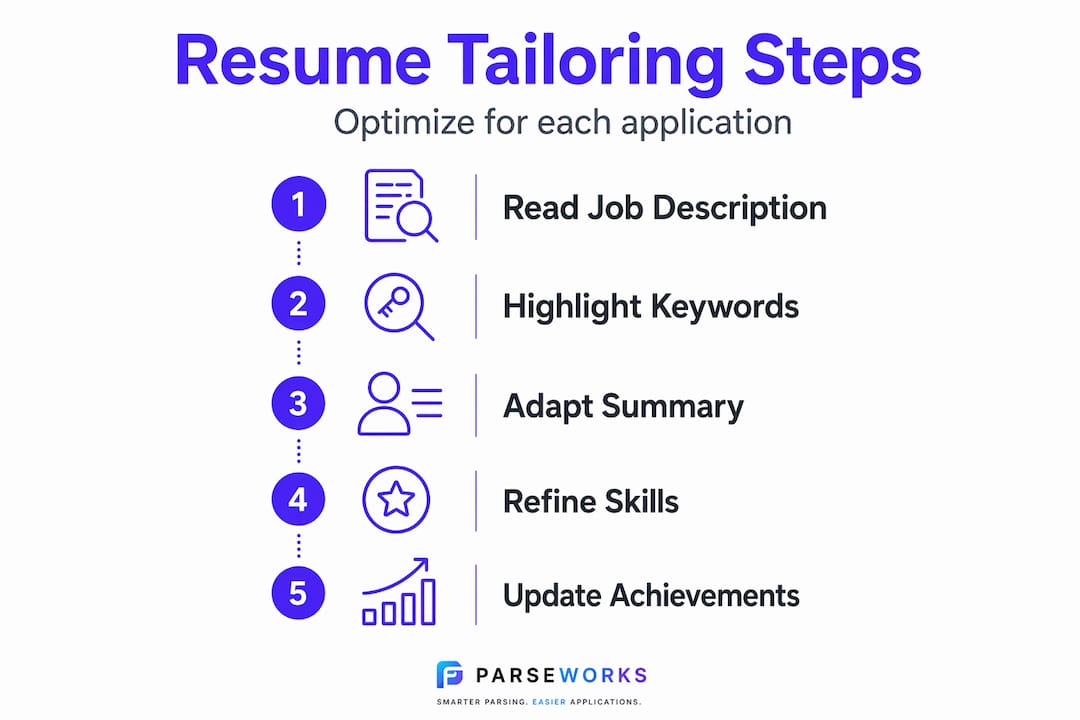
Start by reading the job description carefully and highlighting repeated phrases, specific tools mentioned, and anything that appears in both the requirements and the "nice to have" sections. Those repeated terms are your keyword targets.
Tailoring resumes for specific company types or role categories beats generic applications every time. For a prestigious company or highly competitive role, deep manual tailoring is worth the time. For broader searches, keep three to four master resume variants ready and customize lightly from each.
Here is a practical tailoring workflow:
- Identify the top five to six required skills in the posting and confirm each appears on your resume
- Mirror the job title in your summary if it honestly reflects your experience
- Reorder your bullet points so the most relevant achievements appear first in each role
- Swap out generic skills for the specific tools named in the posting
- Cut anything that does not serve this specific application
One timing detail that most job seekers overlook: applying early significantly increases your chance of having your resume reviewed. Recruiters often work through the first fifty to one hundred applications before moving forward. Once a pipeline fills, later applications are frequently screened out before anyone reads them. Set up job alerts and submit within the first 24 to 48 hours of a posting going live.
Pro Tip: Use the job description's own language in your resume. If the posting says "cross-functional collaboration," use that phrase exactly. Do not paraphrase it as "working across teams." ATS scoring is often literal.
Common resume mistakes that cost you interviews
Even well-intentioned resumes carry errors that quietly kill their chances. Here are the most common culprits:
- Buzzword overload. Phrases like "dynamic leader," "passionate self-starter," and "results-oriented" appear on nearly every resume and communicate nothing distinctive. Replace them with specifics.
- Incorrect or missing contact details. A wrong phone number or an unprofessional email address (think: partyguy2003@email.com) immediately undermines credibility.
- Inconsistent date formatting. Mixing "Jan 2022" with "01/2022" and "January 2022" in the same document signals sloppiness to a careful reader.
- Objective statements instead of summaries. An objective tells employers what you want. A summary tells them what you deliver. Employers care about the second one.
- Trying to cram in too much. Every line competes with every other line. Fewer, stronger bullets beat longer, padded ones.
Reviewing your resume with at least two different sources is considered best practice. Ask a peer in your field to review it from a content perspective, and run it through an ATS resume checker for structural and keyword feedback. Neither catches everything on its own.
Treat your resume as a product that is always in development. Resume writing has shifted toward continuous iteration rather than set-and-forget documents. Update it every three to six months even when you are not actively searching. Add new skills, update metrics as projects close out, and remove anything older than ten years that no longer strengthens the picture.
Pro Tip: Read your resume out loud before submitting. If you stumble over a sentence or a bullet point sounds unnatural, a recruiter will feel the same friction. Clear, direct language always wins.
My honest take on resume strategy in 2026
I've reviewed thousands of resumes at this point, and the single pattern I keep coming back to is this: most people treat their resume like a biography and then wonder why it is not working. A biography is about what happened. A resume needs to argue for what you will deliver.
The AI and human approach is genuinely the right one right now. AI tools can surface keyword gaps and flag structural issues faster than any human reviewer. But the moment you let AI write your bullets wholesale, you get the same gray, indistinguishable language that hiring managers see in every other application. The authenticity is gone. What I've found works is using AI for diagnosis and structure, then writing the actual narrative yourself.
The other thing I would push back on is the "apply everywhere" strategy. I've seen people send 300 applications in a month with minimal traction, then switch to 30 targeted, tailored applications and get five interviews. Volume feels productive. Targeting actually is productive.
One more thing that consistently gets underestimated: the timing factor. Early applicants have a measurably better shot at being reviewed. Treat job alerts like stock alerts. When the right role drops, move within hours, not days.
— Sam
How Parseworks helps you get further, faster
If the tailoring and ATS optimization process sounds like a lot of manual work, that is because it is. Most job seekers spend more time reformatting and copy-pasting than actually improving their applications.
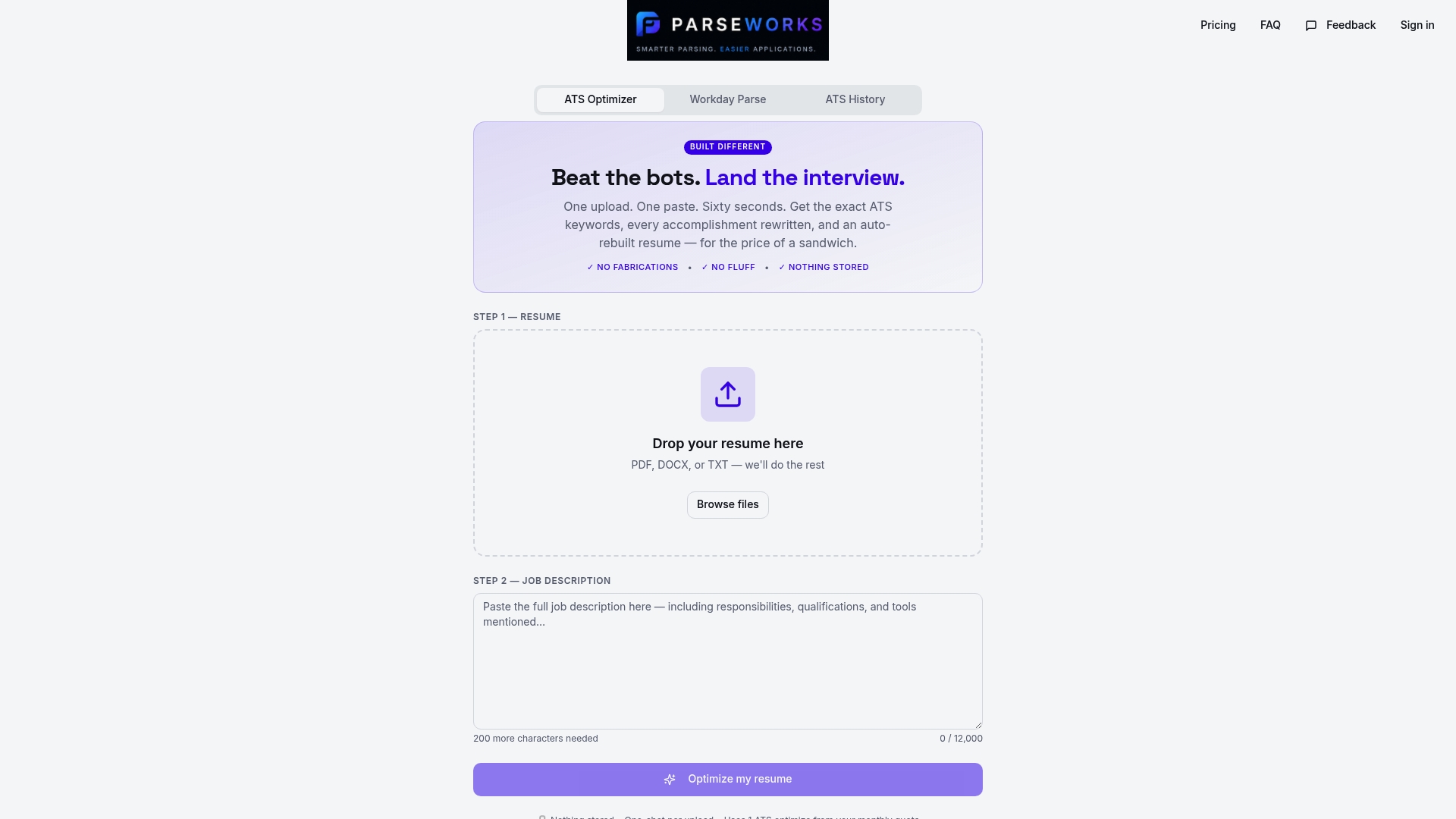
Parseworks is built to cut that friction. The free ATS resume checker scores your resume against real ATS criteria, flags formatting issues, and surfaces keyword gaps before you submit anywhere. The full ParseWorks platform takes it further with resume parsing, bullet rewrite suggestions, and application-ready formatting for platforms like Workday. Check the pricing options to find the plan that fits your search volume. Whether you're applying to five roles or fifty, Parseworks removes the repetitive work so you can focus on the applications that actually matter.
FAQ
What is the best resume format for a competitive job market?
A clean, single-column format with standard fonts and no tables or images works best for ATS compatibility. Use reverse-chronological order for experience and keep the document to one page if you have under ten years of experience.
How do I tailor my resume without rewriting it every time?
Keep two to four master resume versions built around different role types. For each application, adjust the summary, reorder bullet points to lead with relevant achievements, and swap in keywords from the specific job description.
How many keywords should I include on my resume?
There is no magic number, but every required skill and tool listed in the job description should appear somewhere on your resume if you genuinely have that experience. Forced keyword stuffing hurts readability and some ATS systems are now built to detect it.
Does applying early really make a difference?
Yes. Recruiters frequently review only the first applicants in the pipeline before advancing candidates, so submitting within 24 to 48 hours of a posting going live gives you a real structural advantage over later applicants.
How often should I update my resume?
Update it every three to six months even when you are not actively job hunting. Add metrics as projects wrap up, incorporate new certifications, and remove dated experience that no longer strengthens your case for the roles you want.