

You have roughly 6 to 11 seconds to make a hiring manager care about your resume. That's not a metaphor. That's the actual window recruiters spend on an initial scan before deciding whether to read further or move on. For entry and mid-level job seekers, strong resume bullet point examples aren't just helpful. They're the difference between getting called and getting ignored. This article gives you real examples, rewriting strategies, and formatting guidance to make every bullet count.
Table of Contents
- Key takeaways
- 1. What makes resume bullet points actually effective
- 2. Resume bullet point examples by role
- 3. Before and after: rewriting weak bullets into strong ones
- 4. How to organize bullets across your resume
- 5. Tools and techniques to sharpen your bullets
- My honest take on resume bullets after years of watching job seekers struggle
- How ParseWorks can help you write and optimize better bullets
- FAQ
Key takeaways
| Point | Details |
|---|---|
| Lead with action verbs | Every bullet should open with a strong verb that shows what you did, not what your job description said. |
| Quantify whenever possible | Numbers, percentages, and dollar figures make your bullets specific and credible to recruiters. |
| Keep bullets to 1-2 lines | Bullets longer than two lines lose recruiter attention fast during a quick scan. |
| Match job description keywords | Align your top bullets with at least 80% of the job's stated requirements to pass ATS filters. |
| Update your resume regularly | Treat your resume as a living document and add measurable wins as they happen. |
1. What makes resume bullet points actually effective
Before you look at any resume bullet point examples, you need to understand what separates a strong bullet from a weak one. Most job seekers write bullets that describe their responsibilities. Hiring managers don't care what you were supposed to do. They care what you actually accomplished.
The formula is simple: action verb + task + result. That structure forces you to be specific, and specificity is what gets you interviews.
Here's what effective resume bullets consistently do:
- Open with a strong action verb. Words like "spearheaded," "reduced," "built," "trained," "negotiated," and "generated" signal ownership and initiative. Avoid passive openers like "responsible for" or "assisted with."
- Include measurable outcomes. Bullets with quantified results perform better with both ATS software and human readers. If you can attach a number, use it.
- Stay between 15 and 25 words. One to two lines per bullet is the standard. If a bullet wraps to three lines, split it or cut it.
- Align with the job description. Your top bullets should match at least 80% of the role's stated qualifications, using the same language the employer uses.
- Focus on achievements, not duties. Bullets make information digestible in a way paragraphs never can. Use that structure to highlight wins, not job descriptions.
Pro Tip: Scan the job posting and highlight every skill and outcome the employer mentions. Then check whether your bullets reflect those same words and priorities. If they don't, rewrite before you apply.
2. Resume bullet point examples by role
The best way to write strong bullets is to see what they look like in your field. Below are concrete resume bullet point examples across common entry to mid-level roles. Each one follows the action + task + result format.
Customer service
- Resolved 150+ customer inquiries daily via phone and chat, contributing to a 30% improvement in satisfaction scores over two quarters
- Trained 6 new team members on CRM software and complaint resolution protocols, reducing onboarding time by two weeks
- Maintained a 97% first-contact resolution rate across 1,200 monthly interactions by applying active listening techniques
Marketing
- Managed social media content calendar for 4 platforms, growing combined follower count by 22% in 6 months
- Wrote and A/B tested 12 email campaigns, achieving an average open rate of 34% against an industry benchmark of 21%
- Coordinated with design and sales teams to produce monthly product newsletters distributed to 8,000 subscribers
Project coordination and administration
- Organized logistics for 15 internal events per year, consistently delivering within budget and with zero scheduling conflicts
- Maintained and updated a shared project tracker used by a team of 20, reducing missed deadlines by 40%
- Drafted executive correspondence and meeting summaries for a C-suite team of 5, improving response turnaround by 3 days
Retail
- Exceeded monthly sales targets by an average of 18% over a 12-month period through consultative selling techniques
- Processed 200+ transactions daily with 99.8% accuracy, maintaining zero cash register discrepancies for 6 consecutive months
- Recognized as top-performing associate for Q3 2025 out of a team of 35 based on customer feedback scores
These examples work because they give recruiters something concrete to evaluate. Numbers, timeframes, and outcomes replace vague language with verifiable proof.
3. Before and after: rewriting weak bullets into strong ones
Seeing the transformation is often more useful than reading rules. Here are real before-and-after resume bullet point rewriting examples that show exactly how to turn duties into achievements.
| Before (weak) | After (strong) |
|---|---|
| Helped customers with questions and complaints | Resolved 80+ daily customer inquiries, raising satisfaction scores by 25% over one quarter |
| Worked on social media accounts | Grew Instagram following by 4,200 in 90 days by launching a weekly video series tied to product launches |
| Responsible for scheduling and calendar management | Managed executive calendars for 3 directors, coordinating 50+ meetings per month with zero scheduling conflicts |
| Assisted with data entry | Entered and validated 500+ records weekly in Salesforce with 99.9% accuracy, supporting a team of 12 |
| Participated in team projects | Contributed to cross-functional product launch that generated $180K in first-month revenue |
The pattern is consistent across every row. Rewriting vague duties into specific, quantified achievement statements changes how a recruiter reads your experience. It shifts you from someone who showed up to someone who delivered.

Two rewriting frameworks that help:
STAR format (Situation, Task, Action, Result): Useful when you have a specific story to tell. Compress it into one tight bullet.
APR format (Action, Project/Problem, Result): Faster and cleaner for most bullets. Start with what you did, name the context briefly, then state the outcome.
Pro Tip: If you genuinely don't have a number, use comparisons or estimates. "Reduced processing time by roughly half" or "Handled the highest volume of accounts on the team" still communicates impact without a precise figure. Even work without direct metrics can be framed as impactful with the right language.
4. How to organize bullets across your resume
Knowing how to write strong bullets is only half the job. Knowing how many to use and where to place them matters just as much for readability and ATS compatibility.
Here's a practical framework based on experience level and role recency:
| Role type | Recommended bullet count |
|---|---|
| Most recent role (entry level) | 4 to 5 bullets |
| Most recent role (mid-level) | 4 to 5 bullets |
| Roles from 3 to 5 years ago | 3 bullets |
| Roles older than 5 years | 2 bullets or a single line |
| Volunteer or extracurricular (entry level) | 3 to 4 bullets |
Standard practice is 3 to 5 bullets for your most recent role, with fewer for older positions. Entry-level candidates should treat volunteer work, internships, and campus projects with the same bullet rigor as paid roles. Mid-level professionals should taper older roles down to 2 to 3 bullets to keep the focus on recent achievements.
A few additional tips for organizing your bullets well:
- Put your strongest bullet first in each role. Recruiters scan top to bottom and often stop early.
- Vary your action verbs. If every bullet starts with "Managed," it reads as monotonous and suggests limited range.
- For consulting or project-based roles, consider grouping bullets under project names as sub-bullets. This adds clarity without inflating your bullet count.
- Check your resume length against ATS standards before submitting. Bullet count directly affects overall page length.
5. Tools and techniques to sharpen your bullets
Writing strong bullets is a skill, and like any skill, the right tools make it faster and more consistent. Here's what actually helps.
ATS resume checkers scan your resume against a job description and flag keyword gaps, formatting issues, and readability problems. They give you a score before a recruiter ever sees your application. Running your resume through one before submitting is one of the highest-leverage moves you can make.
Keyword optimization tools help you identify which terms from a job posting are missing from your bullets. The goal isn't to stuff keywords into every line. It's to include relevant keywords where they fit naturally, because ATS software reads for context, not just presence.
Iterative writing is underrated. Career coaches recommend writing bullets for one role at a time rather than trying to overhaul your entire resume in one session. Focused, short sessions produce sharper bullets than marathon editing runs.
AI-powered rewriting tools can suggest stronger verbs and tighter phrasing, but they work best as a starting point, not a final draft. You know your work better than any tool does. Use suggestions to spark ideas, then rewrite in your own voice.
Pro Tip: Before you submit any application, paste your resume and the job description into an ATS checker and look at the keyword match score. If you're below 75%, your bullets probably need one more pass to align with the role's language. This one step can meaningfully improve your callback rate.
For Workday-specific applications, formatting matters as much as content. A well-written bullet that breaks during parsing is invisible to the recruiter. Check out this guide on formatting for Workday ATS to make sure your bullets survive the upload intact.
My honest take on resume bullets after years of watching job seekers struggle
I've reviewed hundreds of resumes over the years, and the single most common mistake I see isn't bad grammar or poor formatting. It's that people write their bullets from the perspective of their job description instead of their actual contribution.
Early in your career especially, it's tempting to list what the role was supposed to involve. But recruiters already know what a customer service rep or marketing coordinator does. What they don't know is what you specifically did and what changed because of it. That's the gap your bullets need to close.
I've also noticed that small wording changes produce surprisingly large results. Swapping "helped with" for "led" or "assisted in" for "built" signals a completely different level of ownership. It's not exaggeration. It's precision. If you genuinely led something, say so clearly.
The other thing I'd push back on is the idea that you only update your resume when you're job hunting. That's how you end up scrambling to remember what you accomplished two years ago. Track your wins as they happen. A note in your phone with rough numbers and outcomes takes 30 seconds and saves you hours later.
Your resume is never finished. It's a document you sharpen over time, and the best version of it is always the next one.
— Sam
How ParseWorks can help you write and optimize better bullets
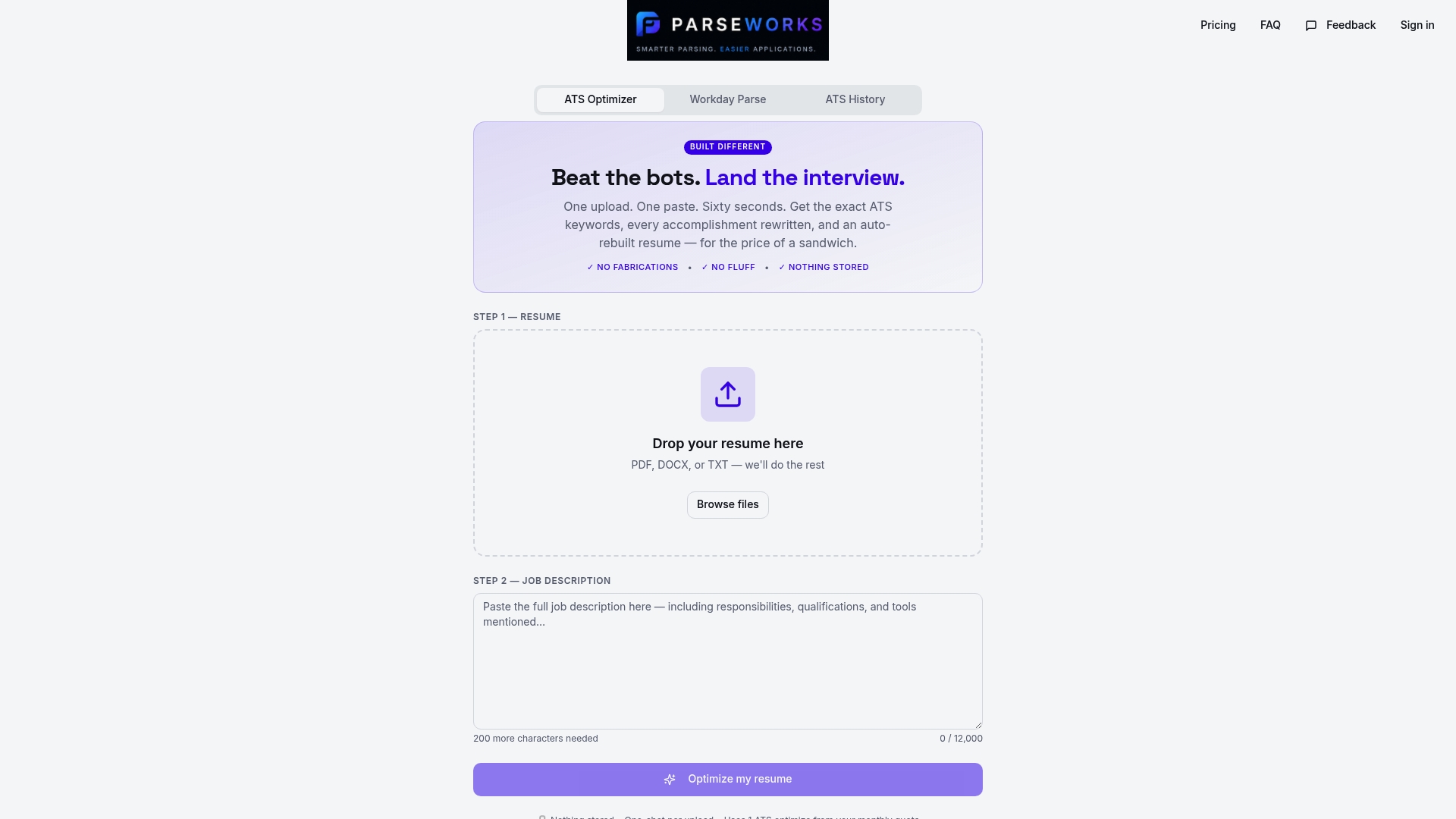
Writing strong bullets is one thing. Making sure they actually get read by ATS software is another. ParseWorks was built specifically to close that gap.
The free ATS Resume Checker scores your resume against a real job description, flags keyword mismatches, and shows you exactly where your bullets fall short before you submit. No guesswork. No waiting for a rejection to figure out what went wrong.
The resume parser pulls your content into a clean, structured format that works with Workday and other ATS platforms without breaking your bullet formatting in the process. If you're applying to multiple roles, the premium optimization features let you tailor bullets to each job description faster than doing it manually.
If you're tired of applying and hearing nothing back, the problem is often your bullets. ParseWorks gives you the feedback to fix them.
FAQ
What are resume bullet points?
Resume bullet points are short, formatted statements under each job listing that describe your responsibilities and achievements. They replace paragraphs to make your experience easier to scan quickly.
How many bullet points should I use per job?
Use 4 to 5 bullets for your most recent role and 2 to 3 for older positions. Entry-level candidates can use up to 5 bullets per role, including volunteer and extracurricular experience.
How do I write a strong resume bullet point?
Start with a strong action verb, describe what you did, and end with a measurable result. Keep it to 15 to 25 words and avoid vague language like "helped with" or "responsible for."
Do resume bullet points need to include numbers?
Numbers strengthen bullets significantly, but they're not always required. If you don't have exact figures, use comparisons or estimates to convey impact. "Handled the highest call volume on the team" still communicates performance without a specific number.
How do I make my bullets pass ATS filters?
Match your bullet language to the job description and include relevant keywords naturally throughout your experience section. Running your resume through an ATS checker before submitting helps identify gaps before they cost you an interview.