

You could be the most qualified candidate in the pile and still never hear back. That's not pessimism. That's how ATS systems work in practice. An ATS system explained simply is this: software that screens your resume before any human ever sees it. Companies can receive up to 2,000 applications for a single job in a single day, and no recruiter reads all of those manually. The software filters, scores, and ranks candidates by criteria. If your resume doesn't survive that process, your qualifications are irrelevant.
Table of Contents
- Key Takeaways
- ATS system explained: what it is and how it's built
- How ATS reads your resume and where it goes wrong
- How to optimize your resume for ATS in 2026
- ATS myths, evolution, and what still matters in 2026
- Popular ATS platforms and what you should know about them
- My honest take after watching this for years
- Apply smarter with Parseworks
- FAQ
Key Takeaways
| Point | Details |
|---|---|
| ATS filters before humans do | Your resume must pass automated parsing and scoring before a recruiter ever reads it. |
| Formatting causes silent rejection | Graphics, tables, and creative layouts often cause parsing failures that discard your resume without notification. |
| Keywords must mirror job descriptions | Use the exact language from the job posting naturally once or twice, not scattered throughout artificially. |
| Different ATS platforms parse differently | Tailoring your resume format to the specific ATS used by an employer can significantly improve your results. |
| Optimization is a two-stage process | Pass the ATS filter first with clean formatting and keywords, then win the recruiter with impact and metrics. |
ATS system explained: what it is and how it's built
An applicant tracking system is centralized recruitment software that acts as both a database and a workflow engine. Every application submitted through a company's career portal flows directly into this system, where it gets parsed, sorted, stored, and tracked across every stage of the hiring process.
Most ATS architectures contain several layers working together:
- Job requisition module: Where hiring managers create and approve open roles.
- Job posting distribution: Syncs listings to job boards like Indeed, LinkedIn, and Glassdoor automatically.
- Resume parsing engine: Converts incoming resumes into structured data fields like name, skills, education, and work history.
- Candidate database: Stores all applicant records for search and retrieval.
- Search and ranking tools: Allow recruiters to filter and score candidates by criteria.
- Workflow engine: Tracks each candidate's progress through interview stages, offers, and rejections, with audit logs for compliance.
The parsing engine is the piece that matters most to you as a job seeker. It reads your resume file and attempts to extract information into those structured fields. If parsing works correctly, your data appears accurately in the recruiter's dashboard. If it fails, your resume may show blank fields or get discarded entirely without any notification to you. The system also integrates with job boards and HR platforms, creating a unified data pipeline from application to hire.
How ATS reads your resume and where it goes wrong

This is where most candidates lose the game before they even knew it started. ATS does not read your resume the way a human does. It scans for structured data, matches terms against job requirements, and assigns a relevance score.
Here are the most common failure modes, in order of how often they knock candidates out:
- Parsing errors from complex formatting. Tables, text boxes, columns, headers, footers, and embedded images all confuse parsing engines. Parsing issues can misassign key fields, pushing your job titles into the wrong category or causing entire sections to vanish. Your resume looks complete on your screen. Inside the ATS, it's scrambled data.
- Keyword mismatches. ATS ranking relies heavily on keyword detection. The system looks for specific terms from the job description in your resume. If you wrote "revenue growth strategy" but the job posting says "go-to-market planning," those may not register as the same thing in older or less sophisticated systems.
- Vendor differences in parsing logic. Different systems may not detect abbreviations or handle formatting the same way. A resume that parses perfectly in Greenhouse might surface incomplete fields in Workday. This is not a minor issue.
- Ranking algorithm weighting. ATS platforms assign relevance scores using weighted factors: keyword frequency, recency of experience, title matching, and required credentials. You may clear the parsing stage but still rank too low for a recruiter to click on your profile.
- Silent rejection. Because 88% of employers have accidentally filtered out qualified candidates due to rigid ATS settings, many rejections are invisible. You never know the resume was discarded at the software stage rather than after a human review.
Pro Tip: Search for the specific ATS platform a company uses before you apply. Many companies list it on their careers page or you can identify it by the URL structure of the application portal. Tailoring your format to that platform gives you a concrete edge.
How to optimize your resume for ATS in 2026
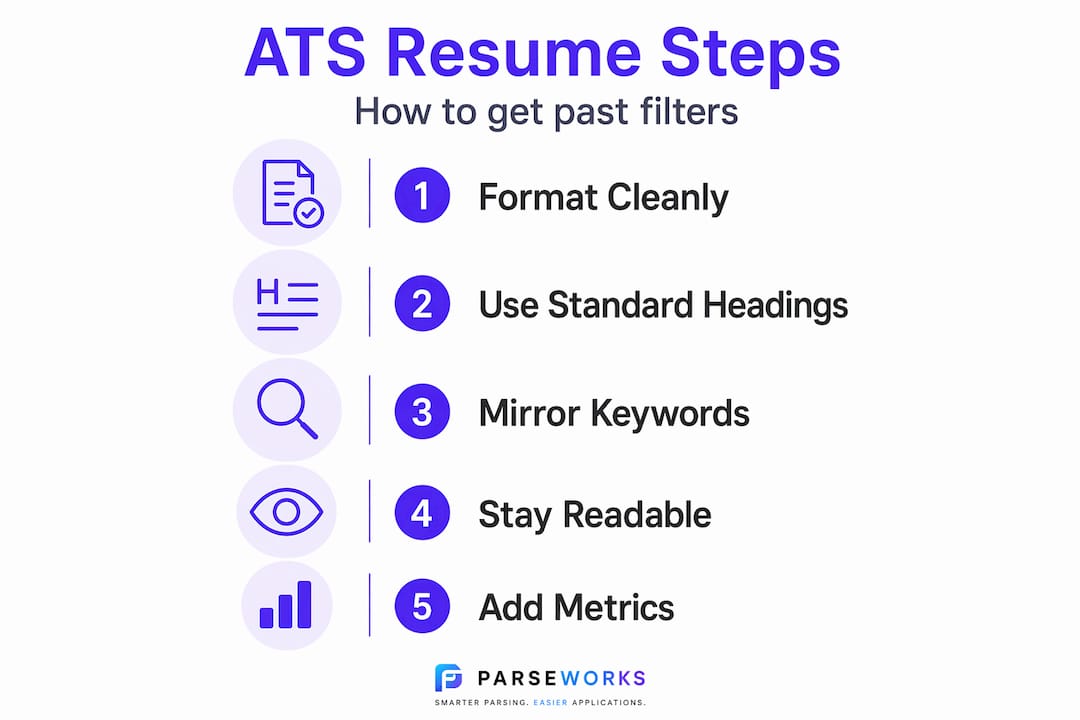
Getting past an ATS requires you to think about your resume as a structured data document first and a personal marketing piece second. That order matters.
Format for clean parsing first
A safe resume format for ATS includes a single-column layout, standard section headings like "Work Experience" and "Education," and plain text contact information at the top. Avoid graphics, charts, logos, and tables entirely. Use DOCX or a simple, non-designed PDF. Review the ATS blacklisted formats that consistently trigger parsing failures before you finalize your design.
Mirror job description language naturally
Read the job posting carefully. Identify the specific tools, skills, and terminology the employer uses. Then incorporate those exact words into your resume where they honestly apply. Keyword relevance remains critical, but natural integration beats repetition. Using a term once or twice in the right context outperforms listing keywords ten times in a skill block.
Balance ATS optimization with human readability
Here is the comparison that matters when you think about your resume's two audiences:
| Resume element | ATS needs | Human recruiter needs |
|---|---|---|
| Section headings | Standard labels ("Experience," "Skills") | Same, but clean visual hierarchy |
| Bullet points | Keywords in context | Quantified results and specific impact |
| File format | DOCX or plain PDF | Clean, readable layout |
| Skills section | Exact terminology from job description | Relevant, credible, not padded |
| Contact info | Plain text, no headers or footers | Clickable email and LinkedIn link |
For your bullet points, prioritize metrics. "Increased pipeline by 34% in Q3" does far more work than "Responsible for sales outreach." Look at resume bullet examples that are built to satisfy both audiences at once.
Pro Tip: After finalizing your resume, paste it into a plain text editor like Notepad. If it reads clearly and all your sections are intact, it will likely parse well. If it looks garbled, your formatting needs work.
Also consider the full ATS-friendly resume format guide for a deeper walkthrough, and check the latest guidance on optimal resume length since both too short and too long can hurt your ranking.
ATS myths, evolution, and what still matters in 2026
Several beliefs about ATS are outdated, and acting on them will hurt more than help you.
The biggest myth is that loading your resume with keywords will push you to the top of the list. Keyword stuffing is flagged by modern ATS and can trigger spam filters or cause your profile to be deprioritized. The days of pasting white text on a white background are long over.
What is actually changing in 2026:
- AI and NLP integration. Modern ATS platforms use natural language processing to score candidates contextually, not just on exact keyword hits. This means your writing needs to make logical sense, not just contain the right words.
- Real-time recruiter dashboards. Recruiters now see funnel analytics and candidate scoring in real time, which means your ranking relative to other applicants is visible and constantly updated as more people apply.
- Video resumes and links. Most ATS still cannot parse video content or links effectively. Including a portfolio URL as plain text is fine. Expecting the ATS to evaluate it is not.
- Cultural fit scoring. Some enterprise ATS platforms now attempt behavioral or culture-fit assessments based on application responses, not just resume text.
"The ATS is the gatekeeper, but it is not the judge. After the software narrows the pool, a human still decides who gets the interview. That means your resume needs to be machine-readable and genuinely impressive."
The human recruiter's role has not disappeared. It has been repositioned. After ATS narrows the field, a recruiter reviews the top-ranked profiles. Your goal is to make both stages of that process work in your favor.
Popular ATS platforms and what you should know about them
Not all ATS platforms behave the same way, and knowing which one a company uses is genuinely useful information. Greenhouse users reduce time-to-fill by 25% and report significant gains in hiring efficiency, which reflects how seriously enterprise employers invest in these tools.
| ATS Platform | Used by | Key features affecting candidates |
|---|---|---|
| Workday | Large enterprises, Fortune 500 | Strict parsing, custom application forms, slow user experience |
| Greenhouse | Tech companies, mid-market | Strong analytics, structured interviews, clean candidate UX |
| Lever | Startups, growth-stage companies | CRM-style pipeline, referral tracking, collaborative hiring |
| iCIMS | Large enterprises | Deep integrations, heavy automation, complex filtering logic |
| SmartRecruiters | Global enterprises | AI ranking, multilingual support, marketplace integrations |
| BambooHR | SMBs | Lightweight, simpler filtering, more human-forward process |
| Ashby | High-growth tech teams | Data-driven, very structured, used heavily in engineering hiring |
If you are applying to Workday-heavy companies, formatting matters even more than usual. Workday's parser is notoriously strict about structure. A dedicated Workday formatting guide walks through exactly what that system needs to read your resume correctly.
My honest take after watching this for years
I've watched talented professionals get filtered out by software that never should have touched them. The most painful version of this is when someone applies to dozens of roles with a beautifully designed resume that looks stunning as a PDF but parses as near-blank inside the ATS. They never find out why they heard nothing.
Here is what I've learned: ATS knowledge is not a silver bullet. Knowing how the system works does not guarantee interviews. What it does is remove a self-inflicted obstacle. Most ATS rejections are avoidable with simple formatting changes and honest keyword alignment. The candidates who figure that out stop wondering why no one is calling.
The uncomfortable truth about high-volume applications is that customization effort matters more than volume. Sending 100 keyword-stuffed, generic resumes will produce fewer results than sending 20 well-tailored, cleanly formatted ones. I've seen this play out consistently. Quantity without quality creates noise. Quality with reasonable volume creates momentum.
Direct outreach and referrals still bypass the ATS entirely in many cases. If you can get a name, send a message. If someone inside a company will pass your resume directly to the hiring manager, that path skips the filter altogether. ATS knowledge is one tool. Networking is another. Use both.
— Sam
Apply smarter with Parseworks
Understanding how ATS works is the first step. Actually fixing your resume for it is where most people get stuck.
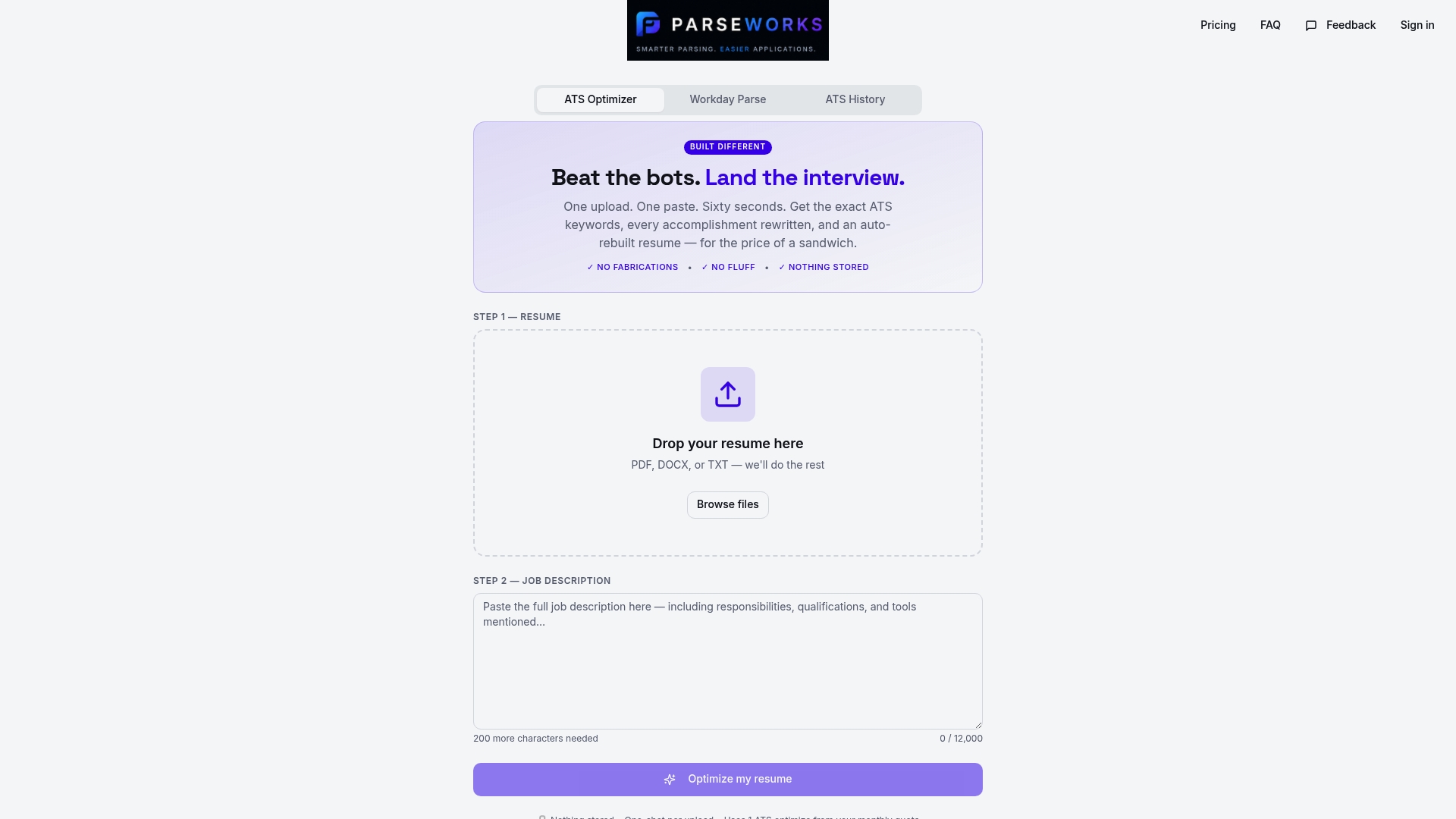
Parseworks is built for exactly this problem. The free ATS resume checker scores your resume against ATS criteria, identifies parsing issues and keyword gaps, and gives you specific recommendations you can act on immediately. No generic advice. No vague scores. Just a clear picture of where your resume stands and what to fix. If you apply to Workday jobs regularly, the Parseworks optimizer also handles resume parsing and reformatting for that platform specifically, cutting down the frustrating manual work of re-entering your information into yet another application form. Spend less time fighting broken systems and more time actually applying.
FAQ
What is an ATS system?
An ATS (applicant tracking system) is software used by employers to collect, parse, filter, and rank job applications before a human recruiter reviews them. It acts as a centralized database and workflow tool for the entire hiring pipeline.
Why do qualified candidates get rejected by ATS?
88% of employers have filtered out qualified candidates due to rigid ATS settings. The most common causes are resume formatting that prevents proper parsing and missing keywords from the job description.
What resume format passes ATS systems best?
A single-column layout with standard section headings, plain text contact information, and a DOCX or simple PDF file format gives you the best chance of parsing correctly across most ATS platforms.
Does keyword stuffing help you rank higher in ATS?
No. Modern ATS platforms detect keyword stuffing and flag it as suspicious. Using relevant keywords naturally, once or twice in context, is more effective than repeating them throughout.
How do different ATS platforms affect your application?
Each platform parses resumes differently and uses its own ranking logic. Workday, for example, requires stricter formatting than platforms like BambooHR. Knowing which ATS a company uses lets you tailor your resume format and improve your chances before you apply.