

Career gaps affect ATS outcomes by disrupting the chronological work history that applicant tracking systems use to calculate your total experience and keyword continuity. Most ATS platforms, including Workday, iCIMS, and Greenhouse, parse your resume's employment dates sequentially and flag periods with no listed activity as missing experience. Gaps longer than six months can reduce your calculated experience score, push you below minimum thresholds, and lower your overall ranking before a human ever reads your name. The good news: over 60% of American workers have taken at least one career break, and the strategies to protect your ATS score are specific and learnable.
How career gaps affect ATS parsing and scoring
ATS platforms read your resume like a timeline. They extract employer names, job titles, and dates, then calculate total years of experience by adding up each role's duration. A gap in that timeline does not just look like a pause. To the algorithm, it looks like missing data.
Here is how the process typically works:
- Date extraction: The ATS pulls start and end dates from each position. Formats like "2021–2023" or "Jan 2021 to Mar 2023" are read differently depending on the system.
- Experience calculation: Total months of employment are summed. If a job requires five years of experience and your timeline shows four years of work plus a one-year gap, many systems score you below the threshold.
- Keyword continuity check: ATS algorithms also scan for relevant keywords across your work history. A gap means a period with zero keyword contribution, which weakens your overall relevance score for that skill.
- Risk flagging: Some systems, particularly AI-powered screeners, flag gaps as a risk marker. This can automatically reduce your ranking in the candidate pool before a recruiter opens your file.
The differences between traditional ATS platforms and newer AI-powered screeners matter here. Legacy systems like older versions of Taleo mostly penalize gaps through experience miscalculation. Newer AI screeners go further. They use predictive models trained on historical hiring data, and those models often associate gaps with lower retention or performance, regardless of the actual reason for the break. This is a structural problem in the technology, not a reflection of your qualifications.
Pro Tip: Format your employment dates consistently throughout your resume. Use "Month Year" format (e.g., "March 2022") rather than year-only entries. Year-only dates give ATS systems less precision and can cause them to calculate gaps as longer than they actually are.

What hiring managers actually think about employment gaps
The ATS is the first filter, but a hiring manager makes the final call. Understanding their mindset helps you frame your gap in a way that survives both layers of screening.
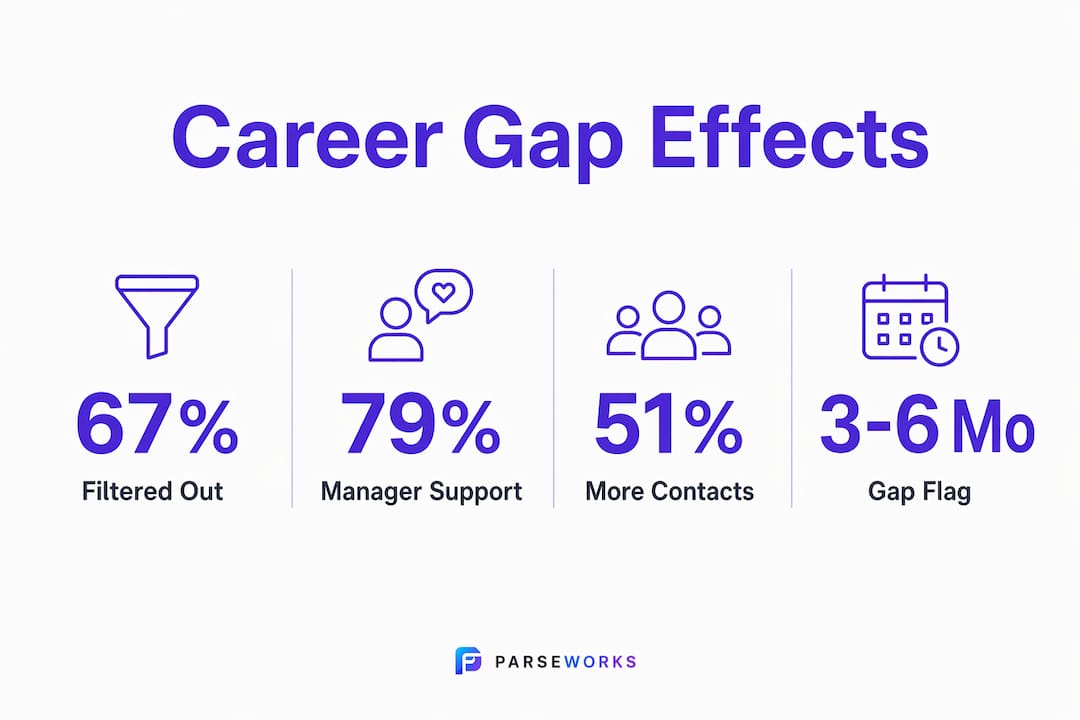
79% of hiring managers would still hire candidates with resume gaps. That is a strong majority. But the same research shows 61% view gaps as a negative signal without context, meaning the gap itself is not the disqualifier. The missing explanation is.
The career break penalty is primarily a risk assessment problem, not a skills assessment problem. Hiring managers worry about motivation, retention, and whether a candidate's skills have drifted. They are not assuming incompetence. They are managing uncertainty. Your job is to reduce that uncertainty with clear, factual information.
What works in your favor:
- Explaining the gap directly: Candidates who provide a clear reason for their break are 51% more likely to be contacted by recruiters. That is a significant lift from one simple addition.
- Linking the gap to skills: Caregiving, freelancing, upskilling through platforms like Coursera or LinkedIn Learning, and volunteer work all count as productive activity. Name them specifically.
- Showing recent relevance: Recruiters prioritize recent relevant experience over long historical credentials when a gap exists. Your most current role or activity needs to be strong and visible.
- Using neutral language: Avoid apologetic framing. "I took time to care for a family member and completed a project management certification during that period" is factual and confident.
"The career break penalty is real, but it is almost entirely a perception problem. Candidates who own their narrative with specificity and confidence consistently outperform those who leave gaps unexplained." — Resilient Recruiter
The hidden risks of automated screening for gap candidates
The risks for candidates with employment gaps go beyond a lower experience score. The deeper problem is that roughly 67% of AI-powered resume screeners penalize employment gaps even when explicitly instructed not to. That number reflects a systemic bias baked into the training data these models learned from, not a deliberate policy choice by employers.
The practical implication is serious. You could be fully qualified, have a well-written resume, and still be filtered out before a human sees your application. This disproportionately affects candidates with caregiving gaps, which skew heavily toward women, and candidates who took breaks for health or education reasons.
Formatting compounds the problem. ATS systems are sensitive to layout. Line spacing outside the 1.0–1.15 range can cause parsing errors that misread your dates or merge separate sections. A misread date can turn a three-month gap into a two-year one in the system's calculation. That kind of error is invisible to you but decisive in the algorithm's ranking.
Pro Tip: After submitting your resume, check whether the ATS-rendered version of your application matches what you submitted. Some platforms like Workday show you a parsed preview. If your dates look wrong in the preview, your formatting needs adjustment before you apply to the next role.
The risk of skipped interview opportunities is real and measurable. A candidate who scores below an ATS threshold rarely gets a second look, even if a recruiter would have been interested. This makes ATS resume optimization a non-optional step for anyone with a gap on their record.
Resume strategies that reduce ATS penalties from career gaps
The right resume structure can significantly reduce the scoring penalty from a gap. These strategies work because they give ATS systems more keyword-rich content, clearer date signals, and a stronger relevance score overall.
Choose the right resume format
| Format | Best for | ATS compatibility |
|---|---|---|
| Chronological | Gaps under six months | High — ATS reads dates easily |
| Combination | Gaps of six months to two years | Medium-high — leads with skills, supports with timeline |
| Functional | Gaps over two years | Low — ATS often cannot parse functional formats accurately |
The combination format is the strongest choice for most gap candidates. It leads with a skills summary or core competencies section that loads your resume with relevant keywords upfront, then follows with a chronological work history that gives the ATS the date structure it needs. Pure functional resumes look appealing in theory but perform poorly in ATS parsing because the systems cannot map skills to specific employers or timeframes.
Fill the gap with listed activity
Add a dedicated entry in your work history for the gap period. Treat it like a role. Give it a title ("Independent Consultant," "Career Development Period," "Family Caregiver"), list the dates, and include two to three bullet points describing what you did. Completed certifications, freelance projects, volunteer leadership, and relevant coursework all belong here. This approach keeps your timeline continuous and adds keywords that would otherwise be missing.
Front-load your strongest keywords
ATS systems weight keywords found earlier in the document more heavily. Place a professional summary at the top of your resume that mirrors the language in the job description. If the posting asks for "cross-functional project management," use that exact phrase in your summary, not a paraphrase. This is especially important for gap candidates because your most recent role may be older than a competitor's.
Understanding which resume sections ATS reads first gives you a clear advantage when deciding where to place your strongest content.
Resume frameworks and language for gap candidates
Concrete language makes the difference between a gap that raises questions and one that reads as a deliberate, productive period. Here are frameworks that work in practice.
Gap entry examples for your work history:
- Career Development Period | Jan 2024 – Oct 2024: Completed Google Project Management Certificate on Coursera. Contributed 120 hours to nonprofit operations as a volunteer coordinator.
- Independent Consultant | Mar 2023 – Dec 2023: Delivered three UX audit projects for small business clients. Maintained active engagement with industry through UXPA webinars and workshops.
- Family Caregiver | Jun 2022 – Feb 2023: Managed full-time caregiving responsibilities. Completed HubSpot Content Marketing Certification during this period.
Cover letter framing that works:
- State the gap in one sentence with a factual reason.
- Name one or two specific activities that kept your skills current.
- Connect those activities directly to the role you are applying for.
- Move on. Do not over-explain or apologize.
Interview framing:
Prepare a 30-second answer. "I took time away from full-time employment to [reason]. During that time, I [specific activity]. I am now ready to bring [relevant skill] to a role like this one." Practice it until it sounds natural, not rehearsed.
For candidates with gaps extending beyond one year, accepting a slightly lower-level role temporarily is a proven way to rebuild recent experience and reduce recruiter concern. A current role at a slightly lower title is more valuable to your ATS score than a prestigious role from three years ago.
Key takeaways
Career gaps affect ATS scores primarily through experience miscalculation and keyword gaps, but strategic formatting, gap entries, and keyword placement can offset most of the penalty.
| Point | Details |
|---|---|
| ATS calculates experience from dates | Gaps reduce your total experience score, which can push you below job thresholds automatically. |
| 67% of AI screeners penalize gaps | This happens even when instructed otherwise, so formatting and keyword density matter more than most candidates realize. |
| Explaining gaps increases contact rates | Candidates who clearly explain their gap are 51% more likely to hear back from recruiters. |
| Combination format outperforms functional | It gives ATS the date structure it needs while front-loading skills and keywords for better scoring. |
| Line spacing affects parsing accuracy | Keep spacing between 1.0 and 1.15 to avoid date misreads that inflate your gap length in the system. |
The framing problem nobody talks about
I have reviewed hundreds of resumes from candidates with employment gaps, and the pattern is consistent. The gap is rarely the real problem. The framing is.
Most candidates either hide the gap entirely, which creates a suspicious-looking timeline, or they over-explain it in a way that reads as defensive. Neither approach works. ATS systems penalize the hidden gap through date calculation. Hiring managers penalize the defensive explanation through gut instinct.
The candidates who get through both filters do something different. They treat the gap as a fact, not a flaw. They name it, describe what they did during it, and connect it to the role they want. That is not spin. That is clarity.
What I find genuinely underappreciated is the keyword problem. A gap is not just a missing time period. It is a missing block of keyword-rich content. Every month you were employed, your resume was accumulating relevant terms from job titles, responsibilities, and tools. A gap stops that accumulation. The fix is not to pretend the gap did not happen. The fix is to fill it with real content that carries real keywords.
The job market in 2026 is more automated than ever, but the human judgment layer still exists. Your goal is to clear the ATS filter with a strong score, then give the hiring manager a confident, specific narrative. Those are two separate tasks, and both are winnable.
If you are managing a gap right now, the worst thing you can do is wait for it to resolve itself. Every additional month without listed activity on your resume is another month of missing keywords and a longer gap for the algorithm to penalize. Start building the record now, even if the work is freelance, volunteer, or educational.
— Sam
How Parseworks helps you apply with confidence despite gaps
Applying with a career gap is hard enough without fighting broken application systems and guessing whether your resume will parse correctly.
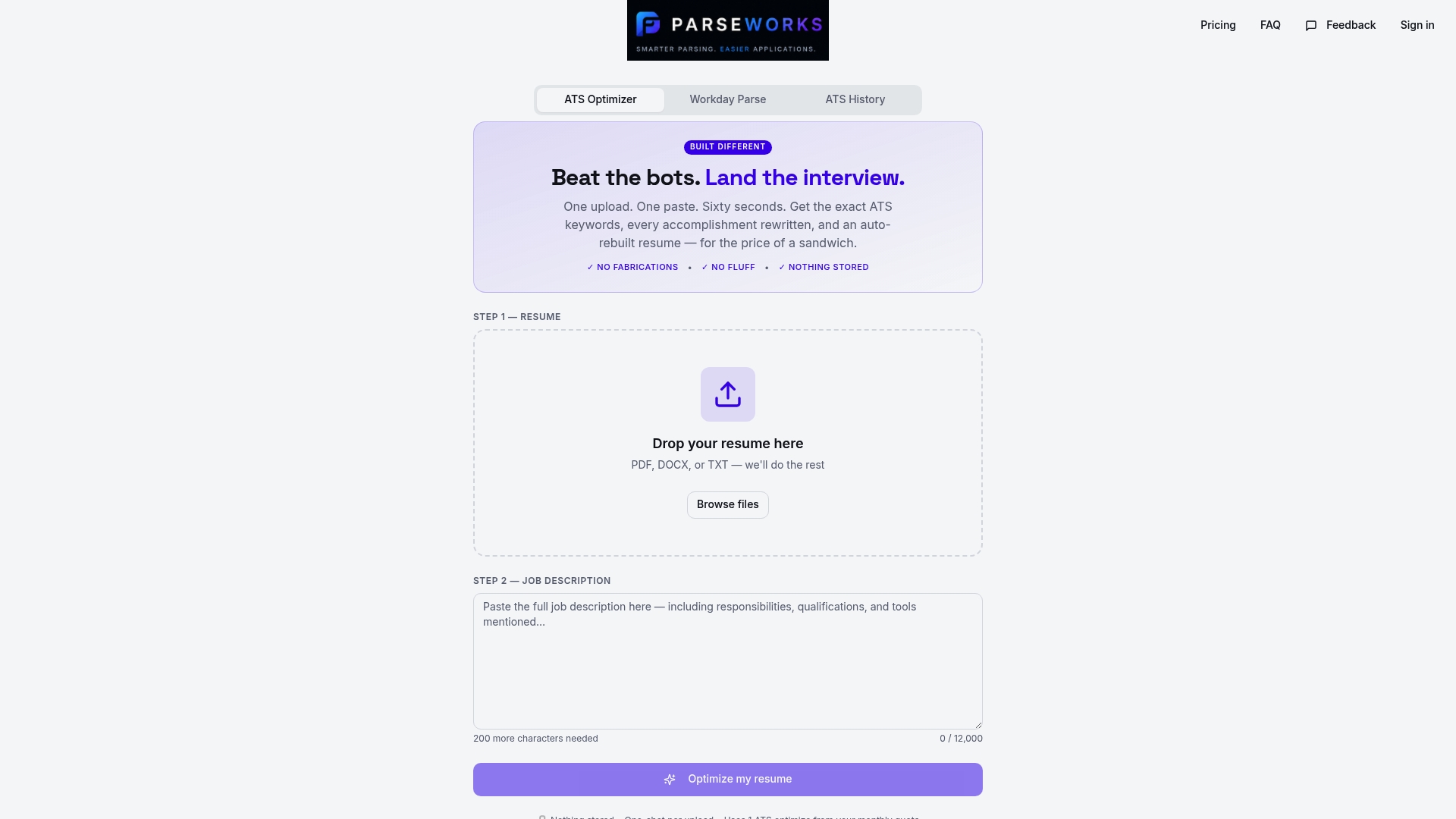
Parseworks is built for exactly this situation. The platform extracts your resume content, scores it for ATS readiness, and flags keyword gaps and formatting issues before you submit. If your dates are being misread or your gap entry is not parsing as a role, Parseworks shows you that before it costs you an interview. The resume optimization tools also suggest rewritten bullet points that strengthen keyword density across your entire work history, including the gap period. For candidates who need every advantage in an automated screening environment, that kind of precision matters.
FAQ
Do career gaps automatically disqualify you from ATS screening?
Career gaps do not automatically disqualify you, but they can reduce your ATS experience score below a job's minimum threshold. Filling gap periods with listed activities and using a combination resume format significantly reduces this risk.
How long does a career gap have to be before ATS flags it?
Most ATS systems begin flagging gaps at three to six months, and the penalty increases as the gap extends beyond one year. Gaps under three months are rarely scored as significant by standard applicant tracking systems.
Does explaining a career gap on a resume actually help?
Yes. Candidates who explain their gap clearly are 51% more likely to be contacted by recruiters. A brief, factual entry in your work history covering the gap period is the most effective way to address it on the resume itself.
What resume format works best for ATS with employment gaps?
The combination format works best. It leads with a keyword-rich skills summary that boosts your ATS relevance score, then follows with a chronological work history that gives the system the date structure it needs to calculate experience accurately.
Can formatting errors make a career gap look longer to ATS?
Yes. Line spacing outside the 1.0–1.15 range can cause ATS parsing errors that misread employment dates, making a short gap appear much longer in the system's calculation. Always check your resume's parsed output when a preview is available.