

Action verbs are the single most effective language tool for communicating your professional value on a resume. They replace vague, passive descriptions with direct evidence of what you actually did, decided, and delivered. The role of action verbs in resume writing goes beyond style. They signal competence to human recruiters and trigger keyword recognition in applicant tracking systems (ATS) like Workday and Greenhouse. MIT's Career Advising and Professional Development office, Indeed, and Coursera all treat strong verb selection as a foundational resume skill. Get this right, and every bullet point on your resume becomes a credibility statement.
How action verbs enhance resume clarity and impact
Action verbs shift the focus of a resume bullet from what your job description said to what you personally accomplished. That distinction matters more than most job seekers realize.
Compare these two versions of the same experience:
| Weak version | Strong version |
|---|---|
| Was responsible for weekly team meetings | Facilitated weekly cross-functional syncs that cut decision lag by two weeks |
| Helped with customer complaints | Resolved 95% of customer escalations within 24 hours |
| Worked on social media content | Produced and scheduled 60+ monthly posts, growing engagement by 40% |
| Involved in budget planning | Managed a $500K departmental budget, finishing 8% under forecast |
The weak versions describe a role. The strong versions describe a person. Recruiters spend an average of six to seven seconds on an initial resume scan, so the first word of every bullet point carries real weight. Action verbs bring energy and confidence to resumes by replacing passive or generic language with direct proof of contribution.
The same principle applies to ATS parsing. Systems like Workday and iCIMS do not reward passive phrasing. They scan for signals of capability, and a verb like "spearheaded" paired with a measurable result reads as a stronger match than "was involved in."
Pro Tip: Start every resume bullet with a past-tense action verb. Present roles use present tense, but every previous position should open with a verb that places you firmly in the driver's seat of the outcome.
What are the best action verbs by category?
Not all action verbs carry equal weight across every role. A marketing manager and a software engineer both need strong verbs, but the right verbs differ by function, seniority, and industry. Below is a curated breakdown.
| Category | Strong verbs | Avoid |
|---|---|---|
| Leadership | Orchestrated, championed, directed, mobilized | Managed, led, oversaw |
| Achievement | Exceeded, maximized, accelerated, delivered | Completed, did, worked on |
| Communication | Presented, negotiated, authored, persuaded | Communicated, talked, discussed |
| Technical | Engineered, deployed, architected, automated | Used, worked with, helped |
| Research | Analyzed, synthesized, evaluated, benchmarked | Looked into, researched |
| Sales and growth | Grew, acquired, converted, expanded | Handled, dealt with |
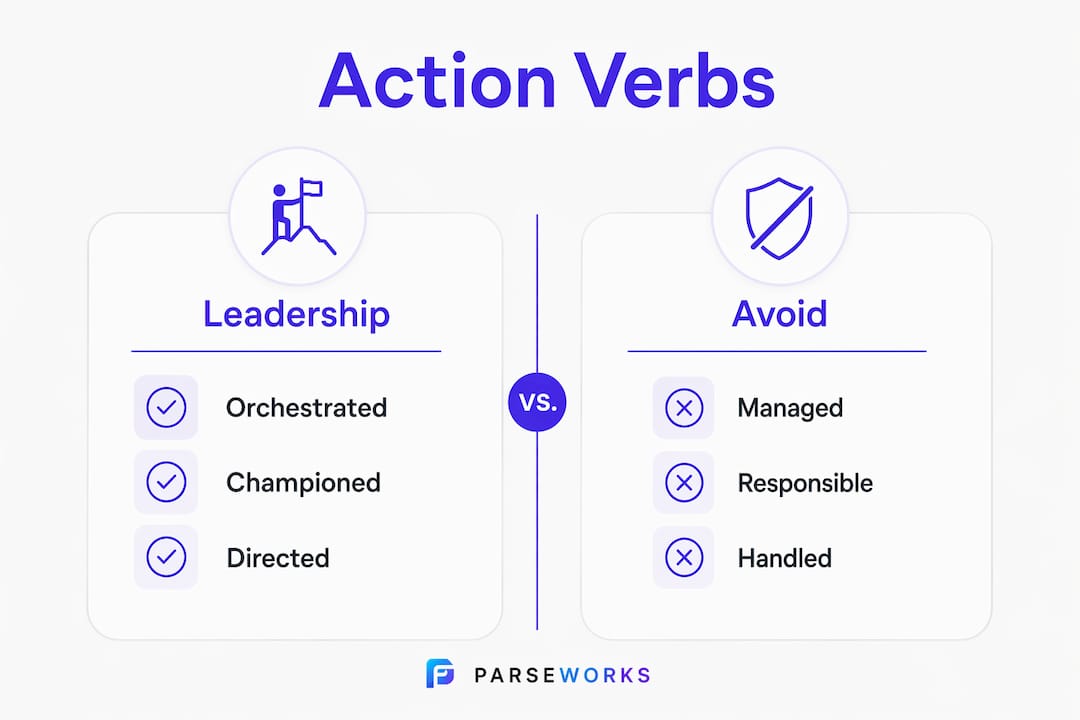
Recruiters are tired of generic verbs like "managed" and "led" and respond better to specific, impactful alternatives like "orchestrated" or "synthesized." This is not about sounding impressive. It is about precision. "Orchestrated a product launch across five markets" tells a recruiter exactly what you did. "Managed a product launch" tells them almost nothing.
For leadership roles, verbs like "championed," "mobilized," and "directed" signal that you drove outcomes rather than supervised them. For technical positions, "engineered," "deployed," and "automated" communicate hands-on expertise rather than passive familiarity. Power verbs highlight leadership, teamwork, and measurable results more clearly than weak alternatives, and employers actively prefer seeing words like "maximized" and "championed" in candidate bullet points.
- Use past tense for all previous roles ("Launched," "Built," "Reduced")
- Use present tense only for your current position ("Lead," "Manage," "Develop")
- Vary your verbs across bullets. Starting five consecutive bullets with "Managed" signals a lack of range
- Pull verbs directly from the job posting when they match your actual experience
Pro Tip: Copy the job description into a text editor and highlight every verb the employer uses. Mirror those exact verbs in your resume where they genuinely reflect your work. This is the fastest way to pass ATS filters without keyword stuffing.
How to select and implement action verbs strategically
Choosing the right verb is a three-step process: match the role, attach a result, and verify ATS compatibility. Here is how to execute each step.
-
Match the verb to the seniority level. Entry-level candidates should use verbs like "assisted," "coordinated," and "contributed." Mid-level professionals move toward "directed," "implemented," and "optimized." Senior leaders use "spearheaded," "transformed," and "established." Using a C-suite verb when your experience is two years out of college reads as overreach.
-
Pair every verb with a quantifiable result. A verb alone is a claim. A verb plus a number is evidence. "Reduced" is weak. "Reduced onboarding time by 30% through a redesigned training program" is a hire-worthy bullet. Listing achievements with strong action verbs in bullet format helps recruiters quickly identify key skills and contributions.
-
Build semantic clusters for ATS recognition. Modern ATS platforms do not just scan for isolated keywords. They analyze semantic clusters involving action verbs plus relevant nouns and quantifiable results. "Spearheaded" plus "initiative" plus "15% growth" registers as a high-quality match. A bare verb with no context does not trigger the same signal.
-
Avoid adverb overload. Overusing adverbs with action verbs dilutes their strength. "Proactively managed" is weaker than "Anticipated and resolved." Let the verb carry the weight. Add an adverb only when it changes the meaning in a way the verb alone cannot convey.
-
Audit for repetition. Read your resume and circle every verb. If any verb appears more than twice, replace the duplicates. Replacing "managed" with "orchestrated" or "championed" provides a fresh, specific narrative that holds a recruiter's attention longer.
Tools like Grammarly and Hemingway Editor can flag passive constructions and weak verb choices. For ATS-specific feedback, Parseworks' ATS resume checker scores your verb usage alongside formatting and keyword density in one pass.
How ATS and hiring trends are reshaping verb choices in 2026
ATS technology has changed significantly in the past three years. Earlier systems matched keywords literally. Current platforms from vendors like Workday, Lever, and Greenhouse use natural language processing to evaluate context, not just presence. That shift has direct consequences for how you should write your resume.

The most important change is the move toward semantic cluster analysis. A resume that says "Spearheaded a cross-functional initiative resulting in 15% revenue growth" scores higher than one that simply lists "leadership" as a skill. The verb, the context, and the result form a cluster that the system reads as meaningful evidence of capability. Semantic clustering in ATS means pairing verbs with related nouns and data creates stronger automated recognition than isolated keywords alone.
The second major shift is the rising value of human skills. Hiring managers in 2026 are screening for candidates who can operate effectively in AI-augmented teams, and that requires a different vocabulary.
- Verbs like "advocated," "mentored," and "navigated" signal emotional intelligence
- "Facilitated," "aligned," and "mediated" demonstrate interpersonal leadership
- "Coached," "cultivated," and "influenced" show the ability to develop others
Verbs emphasizing emotional intelligence and negotiation help distinguish candidates in AI-augmented hiring environments where technical skills are increasingly assumed and human judgment is the differentiator.
The candidates who stand out in 2026 are not the ones with the longest list of tools. They are the ones whose resumes show how they led, decided, and delivered under real conditions. Verb choice is where that story starts.
For a full breakdown of how to align your resume structure with current ATS requirements, the guide on optimizing your resume for ATS covers the technical side in depth.
Key takeaways
Strong action verbs are the foundation of a high-performing resume because they replace vague duty descriptions with direct, measurable evidence of your professional contributions.
| Point | Details |
|---|---|
| Verbs signal capability | Replace passive phrases with direct verbs to show ownership of outcomes, not just participation. |
| Category matters | Match verb strength to your seniority level and function. "Orchestrated" fits a director; "assisted" fits an analyst. |
| Pair verbs with results | A verb plus a quantified outcome creates ATS-recognized semantic clusters and recruiter-ready proof points. |
| Avoid repetition and adverb overload | Audit for duplicate verbs and cut unnecessary adverbs. The verb itself should carry the achievement. |
| Human-skills verbs are rising | In 2026, verbs like "mentored," "advocated," and "navigated" signal the emotional intelligence employers now prioritize. |
Why most resumes fail at the verb level
I have reviewed hundreds of resumes across industries, and the most common problem is not formatting or length. It is that candidates describe their jobs instead of their judgment. They write "managed a team of five" when they mean "rebuilt a struggling team and cut turnover by half." The verb "managed" erases the story. The verb "rebuilt" starts it.
The second mistake I see constantly is verb uniformity. A resume where every bullet starts with "led," "managed," or "supported" reads as a job description, not a career narrative. Recruiters notice the repetition even if they cannot articulate why the resume feels flat. Variety in verb choice signals range of contribution.
What actually works is treating your verb selection as a deliberate editing pass, separate from writing the bullet content. Write the bullet first. Then go back and ask: does this verb show what I decided, built, or changed? If the answer is no, swap it. "Participated in" becomes "contributed to" or better yet "designed." "Helped with" becomes "executed" or "delivered."
The candidates I have seen land interviews consistently are the ones whose resumes read like a track record, not a task list. Action verbs are the mechanism that makes that shift happen. They are not decoration. They are the structural difference between a resume that gets read and one that gets skipped.
— Sam
See how your resume scores on verb strength and ATS fit
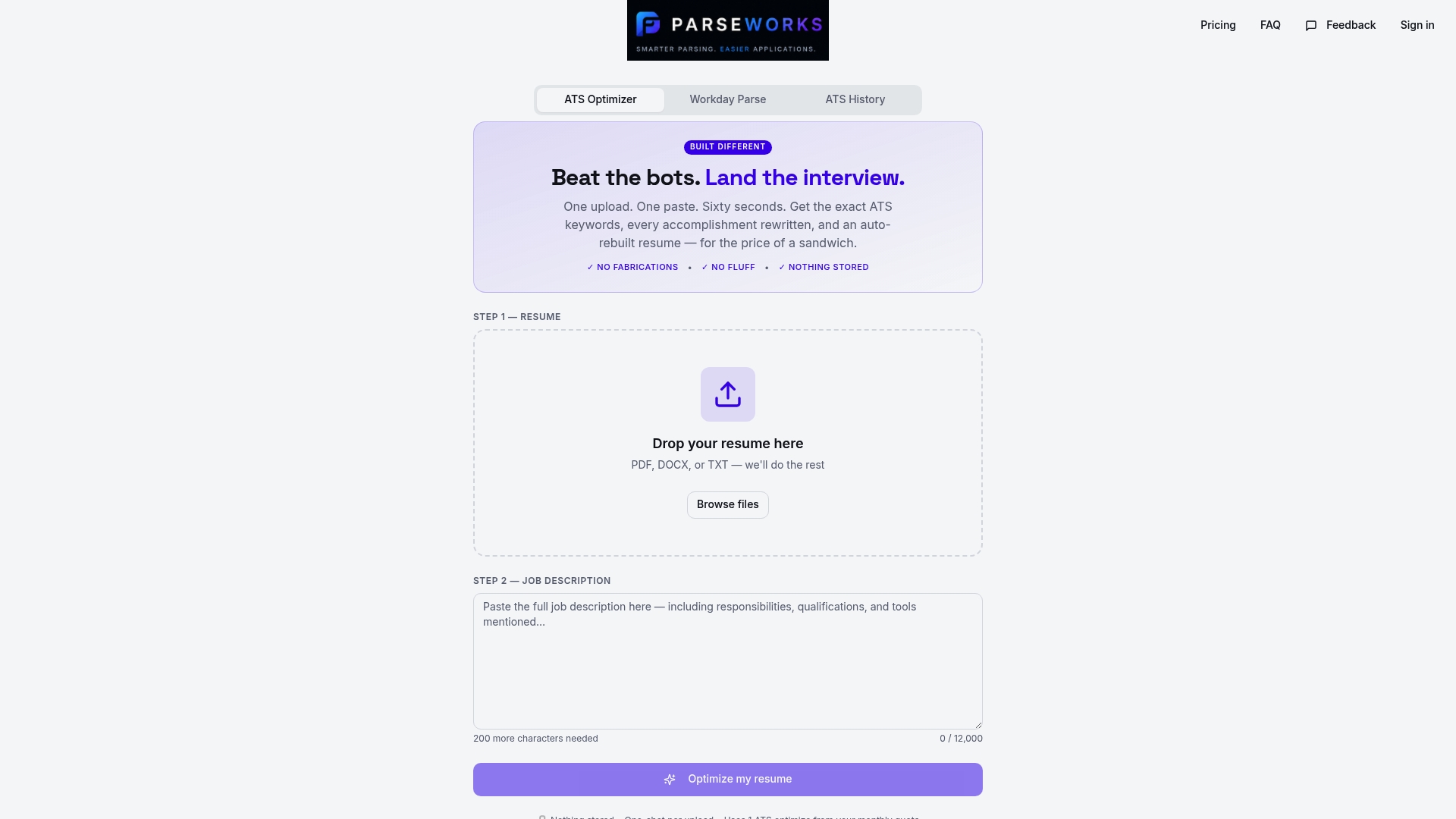
Parseworks' free ATS Resume Checker analyzes your resume for verb strength, keyword density, and ATS compatibility in under a minute. It flags weak or overused verbs, identifies missing semantic clusters, and suggests rewritten bullet alternatives based on your target role. You get a concrete readiness score alongside specific fixes, not a generic report. If you have spent time selecting the right action verbs, this tool confirms whether they are landing the way you intend. Run your resume through Parseworks and find out exactly where you stand before your next application goes out.
FAQ
What is the role of action verbs on a resume?
Action verbs communicate what you personally did, decided, and delivered in each role. They replace passive or vague language with direct evidence of contribution, making your resume more credible to both recruiters and ATS systems.
How many action verbs should a resume include?
Every bullet point should begin with an action verb, so a standard one-page resume typically contains 15 to 25 verbs. The priority is variety and precision, not volume.
Which action verbs do recruiters find most compelling?
Recruiters respond best to specific, role-matched verbs like "orchestrated," "synthesized," "championed," and "accelerated." Generic verbs like "managed" and "led" are overused and fail to differentiate candidates.
Do action verbs affect ATS scoring?
Yes. Modern ATS platforms analyze semantic clusters that combine action verbs with relevant nouns and quantified results. A phrase like "spearheaded initiative driving 15% growth" scores higher than a bare keyword because it provides context the system can evaluate.
Should I use the same action verbs as the job posting?
Mirror the employer's language where it genuinely reflects your experience. Using verbs from the job description improves ATS keyword matching and signals alignment with the role's expectations without misrepresenting your background.