

A resume rebuilding checklist is a structured, step-by-step process for auditing and optimizing your resume so it passes ATS filters and earns attention from human recruiters. Most job seekers lose opportunities not because they lack qualifications, but because their resume fails before a person ever reads it. Nearly 98% of Fortune 500 companies use Applicant Tracking Systems to screen candidates, which means your formatting, keywords, and content structure determine whether you get an interview. Tools like Parseworks and Grammarly exist precisely to close that gap. This checklist covers every critical step.
1. Start with a resume assessment before you change anything
Before rewriting a single word, audit what you already have. Print your resume or open it in a plain text editor and read it as if you are a recruiter seeing it for the first time. Ask three questions: Does this clearly show what I do? Does it match the job I want? Would an ATS parse this cleanly?
A resume assessment checklist at this stage should flag vague job titles, missing metrics, outdated roles, and formatting that breaks ATS parsing. Hiring reviewers cannot infer experience from vague titles alone. Your resume must spell out what you did, how you did it, and what resulted from it. Skipping this audit step means you risk rebuilding on a flawed foundation.

2. Update your contact information and LinkedIn profile
Your contact section is the first thing a recruiter sees and the last thing most people update. Confirm your name, phone number, professional email address, and LinkedIn URL are current and consistent across all platforms. A mismatched LinkedIn profile or a dead email address kills credibility instantly.
Drop your full street address unless the job requires it. City and state are enough for most applications. Add your LinkedIn URL only if your profile is complete and current. A half-finished LinkedIn profile does more damage than no link at all.
Pro Tip: Set your LinkedIn URL to a custom handle (linkedin.com/in/yourname) before adding it to your resume. It looks cleaner and is easier for recruiters to type.
3. Rewrite your professional summary for the specific role
The professional summary is the most underused section on most resumes. Tailoring your professional summary to the target role communicates candidate fit in under ten seconds, which is roughly how long a recruiter spends on a first pass. A generic summary wastes that window entirely.
Write three to four sentences that answer: Who are you professionally? What is your strongest relevant skill or achievement? What are you looking for? Mirror the language from the job description without copying it word for word. If you are applying to five different roles, you need five different summaries.
Pro Tip: Paste the job description into a word frequency tool and note the top five nouns and verbs. Work at least three of them naturally into your summary.
4. Cut outdated and irrelevant experience
Clutter is the enemy of a strong resume. Jobs older than ten years can typically be removed or condensed to a single line unless they are directly relevant to the role you are targeting. Keeping a 2008 retail job on a senior marketing resume signals poor editorial judgment to recruiters.
Remove skills that are no longer relevant to your field. Microsoft Word and basic internet research are not skills worth listing in 2026. Replace them with current tools, platforms, and certifications that match what employers are actually asking for. Shorter and sharper always beats longer and padded.
5. Rebuild your work experience with the WHO method
Every bullet point in your experience section should follow the WHO method: What you did, How you did it, and what Outcome resulted. Strong bullet points start with action verbs and quantify results wherever possible. "Managed a team" tells a recruiter nothing. "Led a six-person content team that reduced production time by 30% over two quarters" tells them everything.
Follow this structure for every role:
- Open with a varied, specific action verb (led, reduced, built, negotiated, launched).
- Describe the task or project with enough context to understand scope.
- State the method or tool you used.
- Quantify the outcome with a number, percentage, or dollar figure.
- Align the language with keywords from the job description.
Pro Tip: If you cannot find a metric, use scale instead. "Managed onboarding for a 200-person department" is more informative than "Managed onboarding processes."
6. Optimize your skills section with job-relevant keywords
The skills section is where ATS systems do a significant portion of their filtering. List hard skills, software, certifications, and methodologies that appear directly in the job descriptions you are targeting. Group them logically: technical skills, tools, languages, certifications.
Keyword placement must be thoughtful and job-specific to pass ATS filters and still read naturally to a human reviewer. Stuffing 40 keywords into a skills section triggers both ATS spam filters and recruiter skepticism. Aim for 12 to 18 skills that you can actually speak to in an interview. Understanding how ATS systems work helps you prioritize which skills to list first.
7. Fix your formatting for ATS compatibility
ATS systems parse resumes by reading text in a specific order. Tables, columns, graphics, text boxes, and headers or footers all break that parsing. Federal resume guidelines from NIST explicitly prohibit images, logos, hyperlinks, and complex formatting because they cause ATS and HR systems to misread or reject applications entirely. The same logic applies to private-sector ATS platforms.
Use a single-column layout with clear section headers. Stick to fonts like Calibri, Arial, or Georgia at 10 to 12 points. Avoid decorative lines, icons, and color-coded sections unless you are in a creative field submitting a portfolio alongside your resume.
| Format element | ATS-safe choice |
|---|---|
| Layout | Single column, no tables or text boxes |
| Font | Calibri, Arial, or Georgia, 10–12pt |
| File format | PDF or DOCX (check job posting for preference) |
| Section headers | Plain text, not inside shapes or graphics |
| Personal data | No photos, Social Security numbers, or birth dates |
For a deeper look at which ATS-blacklisted formats to avoid, the patterns are more specific than most guides admit.
8. Choose the right file format and length
PDF preserves your formatting across devices and operating systems. DOCX is preferred by some older ATS platforms that parse Word documents more reliably. When a job posting specifies a format, follow it exactly. When it does not, PDF is the safer default for most modern ATS platforms.
Resume length follows a simple rule: one page for under ten years of experience, two pages for ten or more. Federal resumes are capped at two pages under NIST and OPM guidelines and require specific details including job title, employer, dates, hours worked, and clear role descriptions. Private-sector resumes do not carry the same requirements, but the two-page ceiling still applies in most cases.
9. Build a keyword strategy around each job description
A resume optimization checklist for 2026 must include a keyword strategy, not just a keyword list. Read each job description carefully and identify the exact phrases used for required skills, tools, and responsibilities. Copy those phrases into your resume where they fit naturally, particularly in your summary, skills section, and bullet points.
Using a master resume framework with ATS-approved formatting lets you create targeted versions for each application without rebuilding from scratch every time. Keep your master document updated and pull from it when tailoring. This approach saves hours across a long job search and keeps your formatting consistent. Recruitment platforms are also evolving their screening criteria in ways that reward specificity over volume.
10. Proofread with tools and a second set of eyes
A single typo in a resume signals carelessness to a recruiter. Proofreading with Grammarly or a peer review catches errors that self-editing misses, particularly inconsistent tense, punctuation, and capitalization. Run your resume through at least two passes: one for grammar and one for consistency in formatting, dates, and job title capitalization.
Read your resume out loud. This catches awkward phrasing that looks fine on screen but sounds wrong when spoken. Ask someone in your field to review it for clarity and relevance. Fresh eyes catch what familiarity hides.
Key takeaways
A resume rebuilding checklist works because it forces you to address ATS compatibility, keyword alignment, and content clarity in a specific order, not all at once.
| Point | Details |
|---|---|
| Audit before editing | Assess your current resume for vague language, outdated roles, and formatting issues before making changes. |
| Tailor every summary | Rewrite your professional summary for each role to communicate fit within the first ten seconds of review. |
| Use the WHO method | Build bullet points around what you did, how you did it, and the measurable outcome achieved. |
| Fix formatting first | Single-column layouts, ATS-safe fonts, and clean file formats prevent parsing failures before content is ever read. |
| Build a master resume | Maintain one well-formatted master document and create targeted versions per application for speed and consistency. |
What I've learned from watching job seekers get this wrong
Most people treat resume rebuilding as a one-time fix. They update it after a layoff, submit it everywhere, and wonder why nothing comes back. The real problem is that a resume is not a static document. It is a targeting instrument, and it needs to be recalibrated for every serious application.
The biggest mistake I see is over-reliance on AI-generated text. Generic bullet points that sound polished but say nothing specific are immediately recognizable to experienced recruiters. A bullet that reads "Leveraged cross-functional synergies to drive organizational outcomes" tells a hiring manager nothing and signals that the candidate did not write it. Specificity is the only thing that builds credibility on paper.
The second mistake is treating ATS optimization as a separate task from writing well. The best resumes I have reviewed pass ATS filters because they are written clearly and specifically, not because someone stuffed in keywords. When you describe your actual work with precision, the right keywords appear naturally.
One more thing worth saying: the copy-paste resume approach is a real liability. Submitting the same document to every job posting without adjustment is one of the fastest ways to get filtered out. Recruiters notice when a resume does not match the role. ATS systems notice even faster.
— Sam
Check your resume score before you apply
If you have worked through this checklist and want to verify your resume is actually ATS-ready, Parseworks gives you a concrete answer fast.
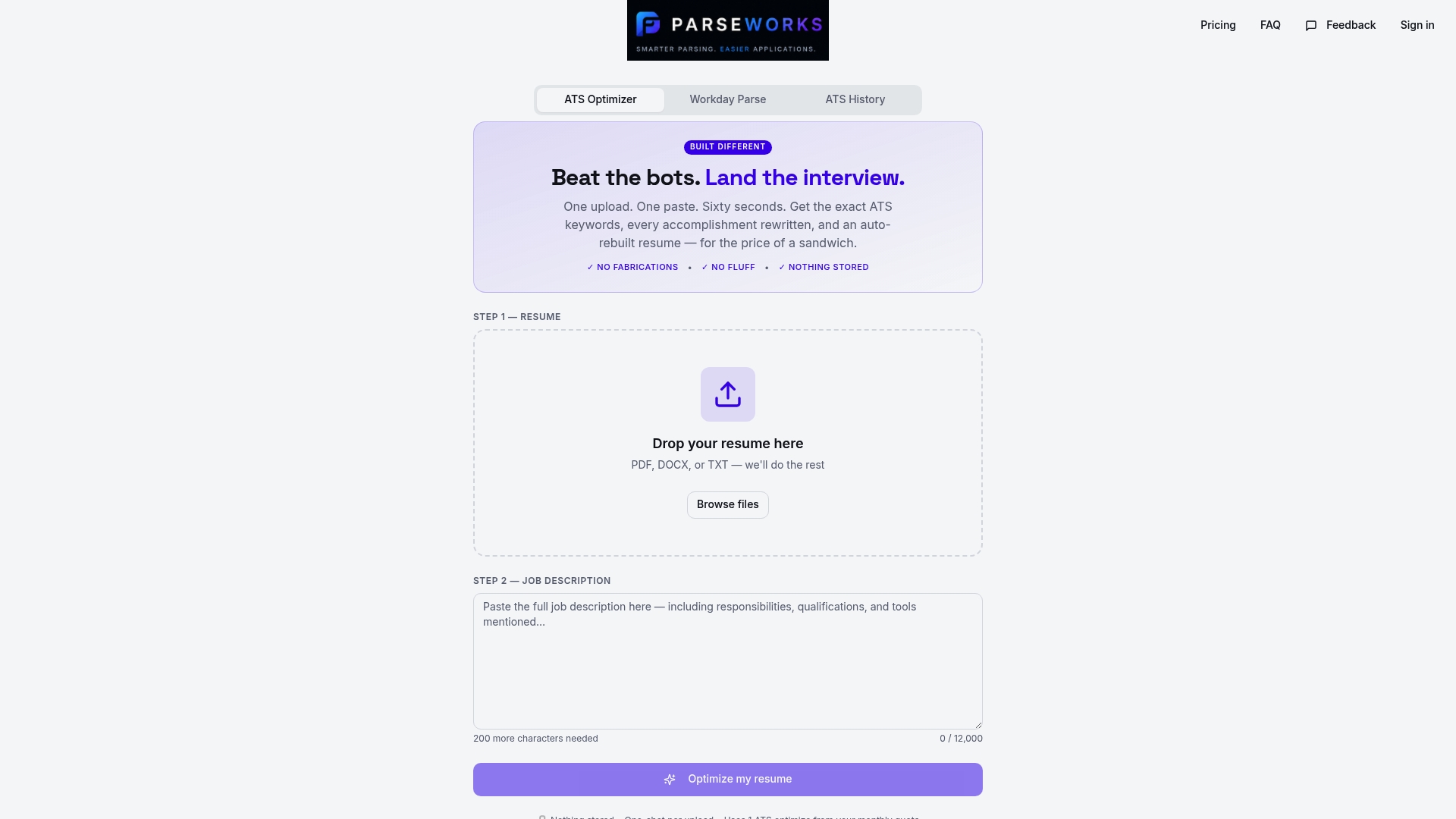
The free ATS resume checker from Parseworks scores your resume against real ATS criteria, flags formatting issues, identifies missing keywords, and suggests specific fixes. You get a readiness score, not a vague report. It takes under two minutes and removes the guesswork from one of the most frustrating parts of job hunting. Run your resume through it after every major revision.
FAQ
What is a resume rebuilding checklist?
A resume rebuilding checklist is a structured set of steps for auditing and improving your resume to pass ATS filters and attract recruiter attention. It covers contact information, professional summary, work experience, formatting, keywords, and proofreading.
How often should you update your resume?
Update your resume before every serious job application, not just when you change jobs. Tailoring your summary and keywords to each role significantly improves your chances of passing ATS screening.
What file format is best for ATS systems?
PDF is the safest default for most modern ATS platforms because it preserves formatting across systems. Some older platforms parse DOCX more reliably, so always check the job posting for a specified format.
How long should a resume be in 2026?
One page is standard for under ten years of experience. Two pages are appropriate for more experienced candidates. Federal resumes follow stricter rules and are capped at two pages under current OPM guidelines.
What makes a bullet point ATS-friendly?
ATS-friendly bullet points use plain text, start with a strong action verb, include job-relevant keywords naturally, and avoid special characters or nested formatting. Quantified outcomes improve both ATS scoring and recruiter engagement.