

Resume rewriting is the strategic transformation of your existing resume into a document that argues clearly and specifically for your next role. It goes far beyond fixing typos or reformatting bullet points. Where editing sharpens what you already have, rewriting rebuilds the content from the ground up to match a new target, a new level, or a new industry. If your resume describes tasks but hiring managers expect to see decisions and impact, you do not have an editing problem. You have a rewriting problem. This guide explains what resume rewriting actually involves, how AI tools fit into the process, and the concrete steps that produce better results.
What is resume rewriting vs. simple editing?
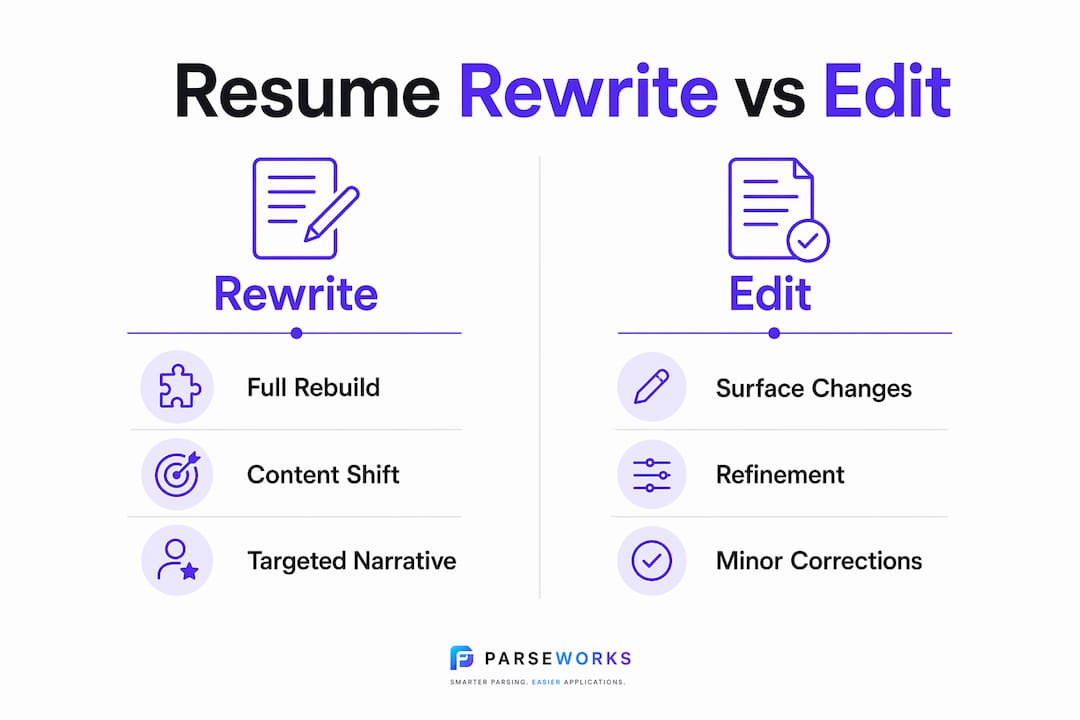
Resume rewriting is the process of rebuilding your resume's content, structure, and narrative to match a specific career target. Editing, by contrast, means improving the clarity and grammar of content that already fits your goal. The distinction matters because most people misuse editing when what they actually need is a full rewrite to reflect the level and scope of their target roles.
Think of it this way: if you are a project manager applying for a director of operations role, your current bullets probably describe what you managed. A director-level resume needs to show what you decided, what you changed, and what the business outcome was. That is not a word swap. That is a structural and strategic overhaul.

A rewrite is necessary when you are changing industries, targeting a significantly senior role, re-entering the workforce after a gap, or when your resume simply is not generating callbacks despite strong qualifications. Editing is appropriate when your resume already fits the role and you just need tighter language or updated dates.
| Characteristic | Resume rewriting | Resume editing |
|---|---|---|
| Scope | Full content rebuild | Surface-level refinement |
| Narrative | Rebuilt around new target | Existing narrative preserved |
| Keyword strategy | Mapped to new job descriptions | Minor keyword additions |
| Story structure | Decisions and impact reframed | Existing stories polished |
| Time required | Several hours to days | 30 minutes to 2 hours |
Pro Tip: Before deciding between a rewrite and an edit, pull three job descriptions for your target role and highlight every skill or outcome they mention. If your current resume addresses fewer than half of those points, you need a rewrite, not a polish.
How do AI tools support the resume rewriting process?
AI tools have changed how job seekers approach a professional resume revamp, but they work best as assistants, not authors. Microsoft Copilot recommends uploading your resume and using targeted prompts like "Help me revise my resume for a marketing manager role" to get structure, clarity, and keyword suggestions. That workflow is genuinely useful for identifying gaps and generating draft language quickly.
The risk appears when job seekers treat a single AI prompt as the finished product. Single-prompt AI rewrites can produce errors, misaligned bullet points, and fabricated details because the model lacks the context to validate every claim. A modular approach, where you parse your resume, run a gap analysis, plan the rewrite section by section, and validate each bullet, produces far more accurate results.
Here is how to use AI tools effectively in your rewriting workflow:
- Upload your full resume and ask the AI to identify which bullets describe tasks versus outcomes.
- Feed in the job description and ask for a keyword gap analysis between your current resume and the role requirements.
- Rewrite one section at a time, not the whole document at once, to catch errors before they compound.
- Ask for three alternative versions of each bullet so you can choose the one that sounds most like you.
- Run a final human review to remove generic phrasing, restore your authentic voice, and verify every claim is accurate.
The risk of AI-generated resumes is polished but generic text that lacks the specific decisions and context that make a candidate memorable. AI is best used for structure and keyword refinement. The stories, the numbers, and the judgment calls have to come from you.
Pro Tip: When using any AI tool for resume rewriting, always add this instruction to your prompt: "Do not invent any metrics or achievements. Only use the information I provide." This one line prevents the most common and damaging AI rewriting error.
What are the tangible benefits of rewriting your resume?
A well-executed resume rewrite delivers measurable improvements across the entire job search process. The benefits are not cosmetic. They affect whether your resume gets read, whether it passes automated screening, and whether it earns a callback.
The most direct benefit is ATS compatibility. ATS-friendly resumes use standard headings, clear date formats, and 8 to 12 targeted keywords mapped directly from job descriptions. That is a specific, achievable target that a rewrite can hit. A resume that was built for a different role three years ago almost certainly misses that target for the role you want today.
Beyond the algorithm, a rewrite improves how a human reader experiences your story. Rewrites rebuild stories around decisions, impact, and business value rather than rephrasing task lists. A hiring manager reading "managed a team of six" learns almost nothing. "Restructured a six-person team's workflow, cutting project delivery time by 30%" tells a story that sticks.
The financial case for a professional resume revamp is also real. Professional resume writing services range from $150 to over $1,000 depending on career stage and scope, with packages that typically include keyword optimization, ATS formatting, and revision rounds. That investment is modest compared to the cost of a prolonged job search. Even a self-directed rewrite that shortens your search by two weeks pays for itself many times over.
Additional benefits include:
- Stronger positioning for senior roles, because rewritten bullets reflect leadership and judgment rather than execution.
- Faster tailoring per application, because a well-structured base resume is easier to adapt quickly.
- Greater confidence in interviews, because your resume accurately reflects the value you bring.
- Reduced friction with ATS platforms like Workday, Greenhouse, and Lever, which parse resumes differently than humans read them.
What practical steps should you follow to rewrite your resume?
A resume rewrite done well follows a sequence. Skipping steps is where most self-directed rewrites fall apart.
-
Audit your current resume against your target role. Pull three to five job descriptions for the role you want. List every skill, outcome, and responsibility they mention. Mark which ones your current resume addresses clearly, which ones it addresses weakly, and which ones it misses entirely. This gap map drives everything that follows.
-
Extract your real stories using the WHO method. WHO stands for What you did, How you did it, and the Outcome it produced. For every role, write out two to three WHO stories before you touch the resume. These become your raw material. Effective tailoring starts with a strong base of specific, outcome-focused content.
-
Map keywords from the job description into your rewritten bullets. Do not just add keywords to a skills section. Weave them into your experience bullets where they are accurate and supported by context. This satisfies both ATS parsing and human readers who scan for relevance.
-
Rewrite section by section, not all at once. Start with your summary, then your most recent role, then work backward. Validate each section before moving to the next. This is the same modular logic that validated rewriting pipelines use to reduce errors in AI-assisted workflows.
-
Run an ATS compatibility check before you submit anything. Check your resume's ATS length and formatting against current standards. Confirm that your headings use standard labels like "Experience" and "Education" rather than creative alternatives that ATS software cannot parse.
Pro Tip: After completing your rewrite, read your resume out loud. If a sentence sounds like it was written by a committee or a chatbot, rewrite it in the first person and then remove the "I." Your resume should sound like a confident, specific version of how you actually talk about your work.
Key takeaways
A resume rewrite is not an edit. It is a strategic rebuild that repositions your experience to argue for a specific next role, and it requires structured steps, targeted keywords, and authentic storytelling to work.
| Point | Details |
|---|---|
| Rewriting vs. editing | Rewriting rebuilds content and narrative; editing only refines what already fits the target role. |
| AI as assistant | Use AI tools like Microsoft Copilot for keyword gaps and structure, but validate every bullet yourself. |
| ATS keyword targeting | Map 8 to 12 keywords from job descriptions into your experience bullets for ATS compatibility. |
| Modular process | Rewrite section by section and validate each part before moving forward to avoid compounding errors. |
| Professional services | Resume writing services cost $150 to $1,000-plus and are worth considering for senior or career-change rewrites. |
The misconception that's costing job seekers interviews
Most job seekers I talk to believe they have already rewritten their resume when they have actually just edited it. They changed a few verbs, added a skill or two, and called it done. That is not a rewrite. That is maintenance.
The real problem is that most resumes are written to describe what someone did, not to argue for what they should be trusted to do next. Those are fundamentally different documents. A resume for a senior individual contributor and a resume for a first-time manager can cover the exact same work history and still need to be completely different documents because they are making different arguments to different readers.
I have also seen the opposite mistake: job seekers who hand everything over to an AI tool and submit whatever comes back. The AI-written fatigue that recruiters describe is real. Generic, polished text with no specific decisions, no real numbers, and no authentic voice reads as hollow the moment a human looks at it. The technology is genuinely useful for structure and keyword work. It cannot replace the specific context that makes your experience credible and memorable.
The best resume rewrites I have seen combine both: a structured, keyword-mapped framework built with tools and a clear process, filled in with specific, first-person stories that only the candidate could have written. That combination is what actually moves the needle on callbacks.
— Sam
Check your rewritten resume against ATS before you apply
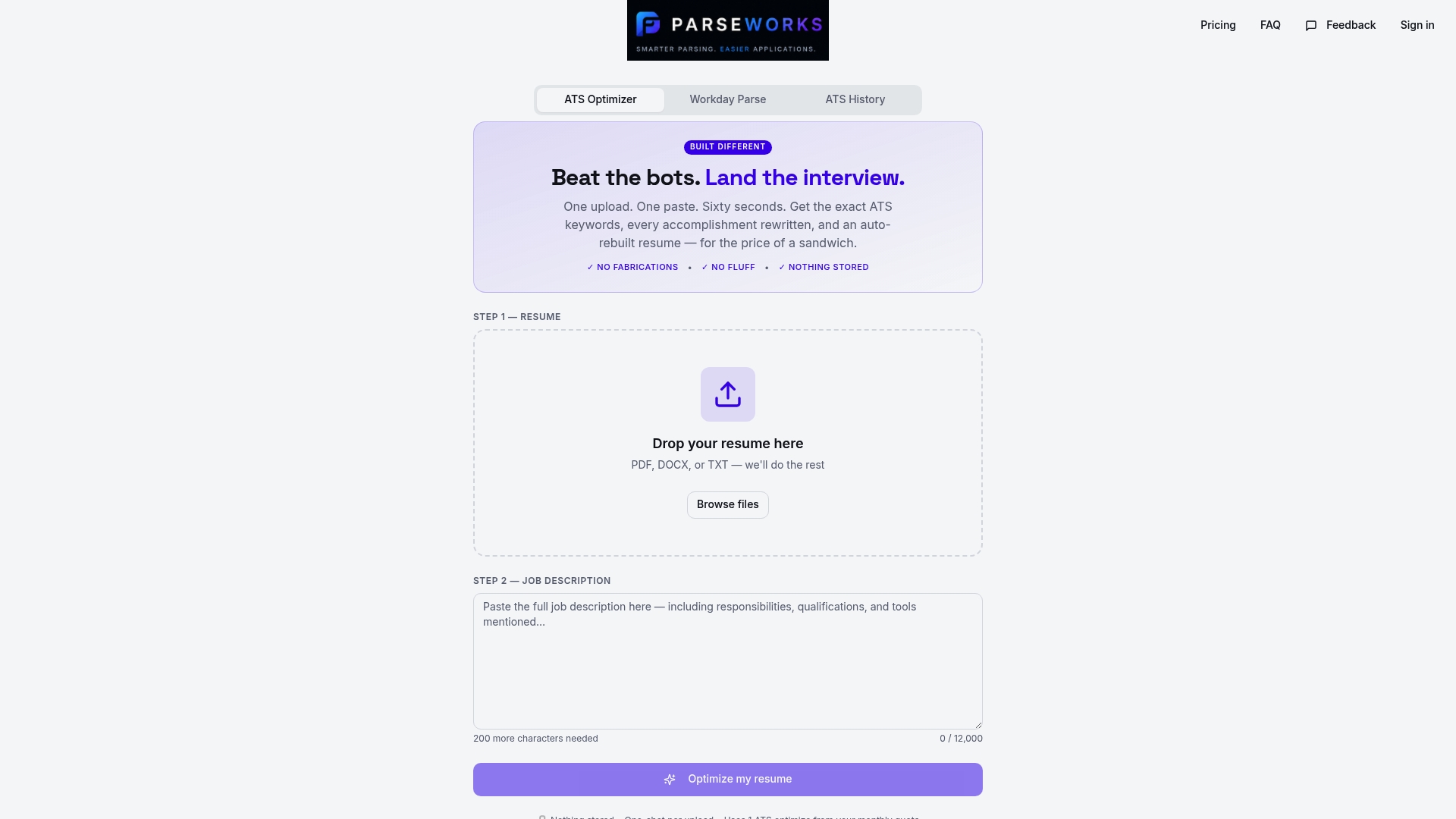
A rewrite is only as effective as its ability to survive ATS screening. ParseWorks gives you a fast, practical way to check exactly that. The free ATS resume checker scores your rewritten resume for keyword alignment, formatting compatibility, and parsing accuracy against ATS platforms including Workday. You see exactly where your resume passes, where it fails, and what to fix before a single application goes out. ParseWorks also handles the parsing and formatting work that makes your rewritten content readable by automated systems, not just human eyes. If you have put the work into a real rewrite, make sure it actually gets read.
FAQ
What is the difference between resume rewriting and editing?
Resume rewriting rebuilds your content, structure, and narrative to fit a new target role. Editing refines existing content that already fits your goal. If your resume is not generating callbacks for the roles you want, you likely need a rewrite, not an edit.
How long does it take to rewrite a resume?
A thorough self-directed resume rewrite typically takes several hours to a few days, depending on how far your current resume is from your target role. Starting with a strong base resume and a clear keyword map from the job description speeds up the process significantly.
Can AI tools fully rewrite my resume?
AI tools like Microsoft Copilot are effective for keyword analysis, structural suggestions, and draft language, but they should not be used as the sole author. Single-prompt AI rewrites produce generic text and occasional inaccuracies. Human review and authentic storytelling are required for a resume that stands out.
What should I include in a resume rewrite?
A resume rewrite should include a targeted summary, experience bullets rebuilt around decisions and outcomes, a keyword-mapped skills section with 8 to 12 role-specific terms, and an ATS-friendly format with standard headings and clean date formatting.
How much do professional resume rewriting services cost?
Professional resume rewriting services range from $150 to over $1,000 in 2026, depending on career stage, industry, and scope. Most packages include keyword optimization, ATS formatting, and at least one round of revisions.