

A skills-based resume places your core competencies front and center, making your qualifications visible before a recruiter ever reads your job history. In the industry, this format is also called a functional resume, though the modern hybrid version has largely replaced the pure functional approach. Examples of skills-based resumes consistently outperform chronological formats for career changers, recent graduates, and professionals with employment gaps. This article breaks down exactly what these resumes look like, which formats work best in 2026, and how to build one that passes both ATS screening and human review.
1. What makes an effective skills-based resume example
The strongest skills-based resume examples share one defining feature: skills are organized into three to five broad, relevant categories, each supported by measurable achievement bullets. Organizing skills into broad groups and expanding each with specific accomplishments is the structure Indeed identifies as most effective. This approach tells a recruiter exactly what you can do and proves it with evidence.
Each category should reflect a real job requirement. Common category headers include Communication, Project Management, Data Analysis, and Technical Proficiency. Under each header, you write two to four bullet points that demonstrate the skill in action, not just list it.

The work history section stays brief. Each accomplishment bullet should be specific to the target job, while the work history section reflects only company name, job title, and dates. This keeps the focus on what you can do rather than where you worked.
Formatting matters as much as content. Use a single-column layout, standard fonts like Calibri or Arial, and clear section headers. Avoid decorative elements that distract from the content.
Pro Tip: Copy five to eight keywords directly from the job description and check that each one appears at least once in your skills categories or bullet points. This single habit closes most of the gap between a rejected and a shortlisted resume.
2. Examples of skills-based resume formats and their ideal uses
Three formats dominate the skills-focused resume space, and each serves a different job seeker situation. Understanding which one fits your background prevents a common mistake: choosing a format that signals weakness instead of strength.
The functional resume leads with a large skills section and buries or omits work history. It suits career changers and candidates with significant employment gaps. The serious downside is that functional resumes often score poorly on ATS parsing and can appear to recruiters as an attempt to hide a weak employment record. Use this format only when the skills section is genuinely exceptional and the role does not require a traditional career path.
The combination (hybrid) resume merges a strong skills section with a clear chronological work history. This is the format most hiring managers and ATS systems respond to best. Career changers benefit most here because they can lead with transferable skills while still providing the employment timeline recruiters expect. FoundRole.com recommends the hybrid format in most cases for exactly this reason.
The chronological resume with a strong skills section works well for candidates with linear careers in fields like finance, law, or engineering. The skills section sits near the top but is shorter, acting as a quick-reference summary before the detailed work history.
| Format | Best for | ATS friendliness | Key risk |
|---|---|---|---|
| Functional | Career changers, gap years | Low | Looks like hiding history |
| Combination (hybrid) | Most job seekers | High | Longer, needs tight editing |
| Chronological + skills | Linear careers | High | Skills section can feel generic |
For most readers of this article, the combination format is the right choice. It gives you the skills-first framing you need while satisfying the ATS and recruiter expectation for a clear employment record. You can explore types of ATS resume formats in more detail to match your specific situation.
3. Top examples of skills to highlight in a skills-based resume
The best skills for a resume fall into two categories: hard skills and soft skills. The mistake most job seekers make is listing both in a single undifferentiated block. Grouping them separately, or better yet, grouping them by job function, makes the resume far easier to scan.
Hard skills examples by industry:
- Technology: Python, SQL, AWS, Salesforce, Figma, cybersecurity protocols
- Marketing: Google Analytics, SEO strategy, HubSpot, A/B testing, paid media management
- Finance: Financial modeling, Excel (advanced), QuickBooks, GAAP compliance, risk assessment
- Healthcare: Electronic health records (EHR), patient triage, HIPAA compliance, phlebotomy
Soft skills examples with context:
- Leadership: "Led a cross-functional team of 8 to deliver a product launch 2 weeks ahead of schedule"
- Communication: "Presented quarterly results to C-suite stakeholders, reducing report review time by 30%"
- Adaptability: "Transitioned department workflows to remote operations within 72 hours during organizational restructuring"
The difference between a weak and a strong skills section is specificity. Including numbers, percentages, and timeframes in bullet points strengthens both impact and ATS relevance. A bullet that says "improved customer satisfaction" is invisible. A bullet that says "improved customer satisfaction scores by 22% over two quarters" is a hiring signal.
Grouping related competencies under category headers like Data Analysis or Project Management also improves ATS parsing. Systems are trained to recognize clusters of related terms, not isolated keywords scattered across a page.
Pro Tip: Run your resume through a plain-text test before submitting. Copy the full text into Notepad or TextEdit and check that all skills and bullets are readable. If formatting breaks, your ATS submission will too.
4. How to tailor skills-based resume examples for ATS and hiring managers
ATS compatibility is not optional in 2026. Most enterprise employers use platforms like Workday, Greenhouse, or Lever to screen resumes before a human ever sees them. A skills-based resume that looks polished in PDF form can fail completely if the underlying structure is not parser-friendly.
The core formatting rules are non-negotiable. ATS-friendly formatting requires no text boxes, no graphics, no tables inside the resume body, and no multi-column layouts. Single-column structure with standard fonts and clear section headers is what ORISE and WideJournal both identify as the baseline for reliable parsing. You can find a full breakdown of what to avoid in this guide to ATS blacklisted resume formats.
Beyond structure, keyword matching is the most direct lever you have. Read the job description carefully and identify the exact phrases used for required skills. If the posting says "stakeholder management," use that phrase, not "managing stakeholders." ATS systems often match exact strings, not synonyms.
Here is a practical checklist before you submit any skills-based resume:
- Confirm the layout is single-column with no text boxes or embedded graphics
- Check that section headers use standard labels: Skills, Work Experience, Education
- Verify that at least three to five keywords from the job description appear in your skills section
- Remove all icons, progress bars, and visual skill ratings
- Save the file as a .docx or plain PDF, not a designed PDF from Canva or similar tools
Employers expect skills mapped directly to real job requirements. Tailoring each submission takes 15 to 20 minutes but dramatically increases the probability of passing initial screening. For a deeper look at formatting decisions, the ATS-friendly resume format guide covers 2026-specific requirements in full.
AI-driven screening tools are also becoming more common at the recruiter level. Understanding why teams use AI candidate screening helps you anticipate what these systems prioritize, which is skills matched to job requirements, not creative formatting.
Key takeaways
The most effective skills-based resumes combine focused skill categories, measurable achievement bullets, and clean ATS-compatible formatting to pass screening and impress recruiters.
| Point | Details |
|---|---|
| Use 3–5 skill categories | Group competencies under focused headers like Project Management or Data Analysis. |
| Lead with measurable bullets | Every skill claim needs a number, percentage, or timeframe to carry weight. |
| Choose the hybrid format | Combination resumes score higher with ATS and satisfy recruiter expectations for work history. |
| Match job description language | Copy exact phrases from the posting into your skills section to improve keyword matching. |
| Strip heavy formatting | Remove tables, graphics, and multi-column layouts before submitting to any ATS platform. |
Why I think most job seekers use skills-based resumes wrong
After reviewing hundreds of resumes and watching job seekers struggle with the same mistakes repeatedly, the pattern is clear: people treat skills-based resume examples as templates to fill in rather than frameworks to adapt. They copy the structure, paste in their skills, and submit. The result is a resume that looks like every other functional resume in the pile.
The pure functional format is a trap for most people. Recruiters know it signals something is being hidden, and ATS systems penalize it. The combination format is almost always the better choice, yet it gets underused because job seekers assume "skills-based" means "no work history."
The other mistake I see constantly is vague bullet points. "Strong communication skills" is not a skill demonstration. It is a claim with no evidence. Every bullet should answer the question: what did you do, for whom, and what was the measurable result? That structure works for both the ATS and the human reviewer reading your resume at 7 a.m. before their first coffee.
Use skills-focused resume samples as inspiration for structure and category naming, not as scripts. Your actual language, your actual numbers, and your actual job-specific keywords are what make a resume worth reading. The format just creates the conditions for those details to land.
— Sam
How ParseWorks helps you optimize your skills-based resume
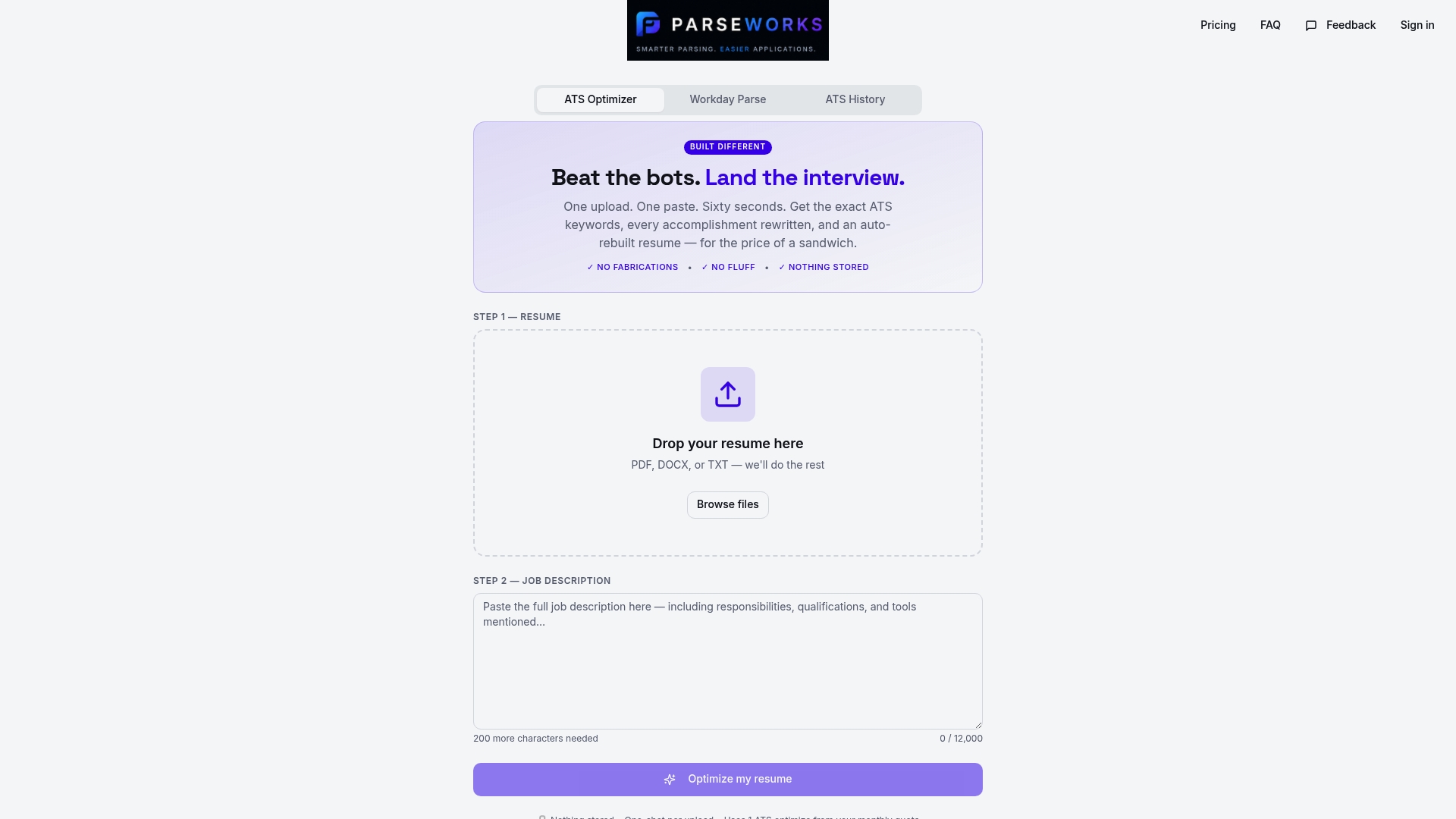
Building a strong skills-based resume is one challenge. Getting it through ATS screening without losing formatting or keywords is another. ParseWorks solves the second problem directly. The platform parses your existing resume, scores its ATS compatibility, and identifies exactly where weak formatting or missing keywords are costing you visibility. You get rewritten bullet suggestions, keyword gap analysis, and application-ready formatting in one workflow, without hours of manual copy-pasting. If you are applying to roles on Workday or similar platforms, the difference between a parsed resume and a broken one is often the difference between a callback and silence. Run your resume through the free ATS resume checker and see your score before your next application.
FAQ
What is a skills-based resume?
A skills-based resume, also called a functional resume, organizes content around core competencies rather than a chronological work history. The skills section leads the document, supported by achievement bullets that prove each competency.
When should you use a skills-based resume format?
Use a skills-oriented resume format when you are changing careers, re-entering the workforce after a gap, or when your skills are more relevant to the role than your specific job titles. The hybrid combination format works best in most of these cases.
Are skills-based resumes ATS-friendly?
Pure functional resumes often score poorly with ATS systems. A combination format with a strong skills section and clean single-column formatting performs significantly better, as ATS parsing requires no graphics, tables, or multi-column layouts.
How many skills should you list on a skills resume?
Three to five broad skill categories with two to four achievement bullets each is the structure Indeed recommends. More than five categories dilutes focus and makes the resume harder to scan quickly.
What are the best skills to put on a resume in 2026?
The best skills for a resume are the ones that appear in the job description you are targeting. Hard skills like Python, SQL, HubSpot, or financial modeling carry more ATS weight than generic soft skills listed without supporting evidence.