

Resume keywords are specific terms, skills, job titles, and certifications that Applicant Tracking Systems (ATS) scan to determine whether your application is worth a human's attention. The role of keywords in a resume goes far beyond decoration. 88% of qualified applicants are passed over because their resumes lack job-specific terms. That means your qualifications are irrelevant if the right words are absent. Understanding keyword optimization, the recognized industry term for this practice, is the single most controllable factor in whether your resume survives the first cut. Tools like Jobscan and platforms like Parseworks exist precisely because this problem is both widespread and solvable.
What is the role of keywords in a resume?
Keywords in a resume function as signals. ATS platforms, which include systems like Workday, Greenhouse, and Taleo, read your resume the way a search engine reads a webpage. They look for specific terms that match the job description, then assign a relevance score. 80% of resumes are rejected before a recruiter ever sees them, either because of weak keyword alignment or formatting errors. That statistic reflects a structural reality: most job seekers are competing against a machine before they compete against other people.
The importance of keywords in a CV or resume operates on two levels. First, they determine whether your application clears the automated filter. Second, they shape how a recruiter reads your experience once it does. A resume that mirrors the language of the job description reads as immediately relevant. One that substitutes different phrasing, even accurate phrasing, creates friction. Recruiters spend an average of six to seven seconds on an initial scan, and familiar terms accelerate recognition.

Keywords fall into several categories: hard skills (Python, SQL, Google Analytics), tools and platforms (Salesforce, HubSpot, Jira), certifications (PMP, CPA, AWS Certified Solutions Architect), job titles, and soft skills used in context (cross-functional collaboration, stakeholder communication). The most effective resumes use all of these categories, distributed across multiple sections, not stacked into a single skills block.
How do ATS systems actually read and score your resume?
Modern ATS platforms in 2026 use a combination of exact keyword matching and semantic analysis. ATS algorithms require a 70 to 80% keyword match rate with a job description to prioritize a candidate. Semantic matching means the system can sometimes recognize that "revenue growth" relates to "sales performance," but exact matches still carry more weight for critical skills and certifications.
Here is how ATS scoring typically works:
- Exact match keywords pulled directly from the job description carry the highest weight.
- Section placement matters. Keywords found in work experience, skills, and certifications sections are weighted more heavily than those buried in an objective statement.
- Formatting errors like tables, text boxes, headers, and footers can prevent ATS from parsing your content at all, making even perfect keywords invisible.
- Keyword context is increasingly evaluated. Systems like Workday's newer parsing engines look for whether a keyword appears in a meaningful sentence or just a list.
- Frequency and distribution signal depth of experience. A keyword appearing once in a skills list reads differently than one appearing in a summary, a job description, and a measurable achievement.
Pro Tip: Before submitting any application, paste your resume and the job description into a plain text comparison. Count how many of the job's core terms appear in your resume. If you are below 70%, you are likely below the ATS threshold.
Resume formatting also affects how well ATS reads your keywords. Clean, single-column layouts with standard section headers like "Work Experience," "Skills," and "Education" parse most reliably. For a deeper look at ATS formatting rules that affect parsing, the specifics matter more than most job seekers realize.
How to select and incorporate keywords effectively
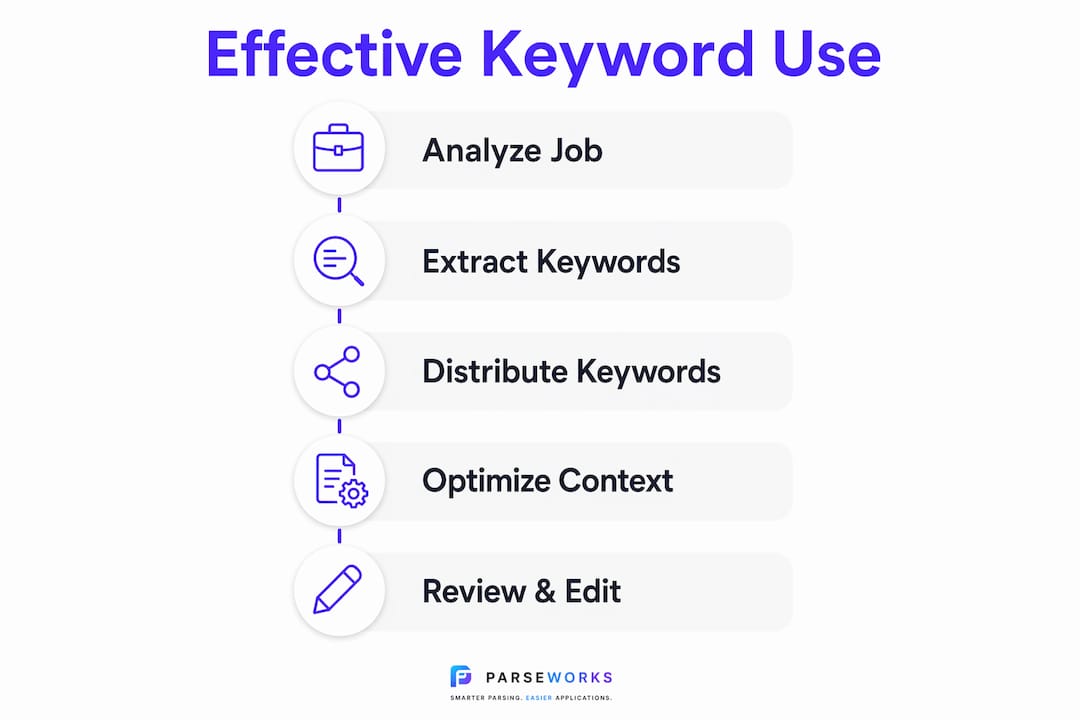
Finding the right keywords starts with the job description itself. Read it three times: once for the overall role, once to identify repeated terms, and once to note the exact phrasing used for skills and responsibilities. Employers write job descriptions using the language their ATS is configured to search. Mirroring that language exactly, rather than substituting synonyms, yields better ATS rankings.
Follow this process to build your keyword list:
- Identify core keywords. These are the terms that appear multiple times or are listed under "Required Skills." For a data analyst role, that might be SQL, Tableau, and data visualization.
- Capture secondary keywords. These appear once but reflect the role's context. Terms like "cross-functional reporting" or "stakeholder presentations" signal cultural and functional fit.
- Note nuanced language. If the job description says "agile methodology" rather than "scrum," use their phrasing. Exact terminology from the job description is preferred by ATS over synonyms.
- Include both acronyms and full forms. Writing "Project Management Professional (PMP)" covers both search variations. This strategy ensures ATS recognizes your credentials regardless of which version the recruiter searches.
- Layer keywords across sections. Place your most critical terms in the professional summary, the skills section, and at least two work experience bullet points.
Industry-specific examples help illustrate this. A marketing professional targeting a content strategy role should include terms like SEO, content calendar, editorial planning, and conversion rate optimization. A software engineer applying to a backend role should prioritize REST APIs, microservices, CI/CD pipelines, and the specific languages listed. Generic terms like "team player" or "hard worker" add no keyword value and consume space.
Pro Tip: Copy the job description into a free word frequency tool like WordCounter. The terms that appear most often are your highest-priority keywords. Build your resume around those first.
For a broader look at resume best practices that combine keyword strategy with human readability, the intersection of both factors is where strong candidates separate themselves.
How to balance keyword frequency and context
Keyword frequency has a ceiling. Optimal keyword inclusion is two to three times per key term, distributed naturally across your resume. Beyond that, repetition reads as stuffing to both ATS and recruiters, and it actively harms your score.
The table below shows the difference between weak and strong keyword integration:
| Approach | Example | Effect |
|---|---|---|
| Isolated skills list | "Skills: Python, SQL, data analysis" | Passes basic ATS scan but provides no context |
| Keyword in summary | "Data analyst with 5 years of Python and SQL experience" | Adds context and signals depth |
| Keyword in achievement | "Built a Python pipeline that reduced reporting time by 40%" | Highest ATS and recruiter value |
| Keyword stuffing | "Python Python data analysis SQL SQL SQL" | Penalized by ATS, rejected by recruiters |
Contextual keyword use in measurable achievements boosts both ATS scores and recruiter interest more than isolated skill lists. The reason is straightforward: a keyword embedded in a result proves you used the skill, not just that you listed it.
Synonyms and variations also play a role. If the job description uses "project management" in one place and "program management" in another, include both. Modern ATS systems recognize related terms, but they still reward exact matches for the most critical qualifications.
Pro Tip: Write your work experience bullets using the formula: Action verb + keyword + measurable result. "Managed SQL database migrations that improved query speed by 35%" is stronger than "Responsible for SQL databases" in every dimension that matters.
Common keyword mistakes that cost you interviews
Most keyword errors fall into predictable patterns. Recognizing them is the fastest way to fix a resume that is not generating callbacks.
- Sending the same resume to every job. Tailoring your keywords to each job description is a competitive advantage, not optional. A resume optimized for one role will underperform against a different job's ATS configuration.
- Relying only on a skills section. A standalone list of skills without contextual usage in work experience misses the higher-weighted sections that ATS prioritizes. Keywords need to appear where you did the work.
- Using vague or outdated job titles. If your previous title was "Digital Evangelist" but the job description says "Digital Marketing Manager," use the industry-standard term in your summary. ATS will not translate creative titles into searchable ones.
- Ignoring role-specific nuances. A keyword that works for a senior role may be irrelevant for a mid-level position. "P&L ownership" belongs on a director-level resume, not a coordinator's. Mismatched seniority signals confuse ATS scoring.
- Skipping ATS testing before submission. Submitting without checking your keyword match rate is the equivalent of sending a cold email without a subject line. Tools like Parseworks score your resume against real ATS benchmarks before you apply.
- Overlooking formatting errors that block parsing. Even perfect keywords fail if ATS cannot read your file. For a full breakdown of ATS rejection causes, formatting and keyword errors are the two most common culprits.
The fix for most of these mistakes is the same: treat every application as a unique document. Pull the job description, identify the top ten keywords, verify they appear in your summary, skills section, and experience bullets, then run an ATS check before submitting.
Key takeaways
Keywords in a resume determine ATS pass rates and recruiter engagement, and placing them in context within measurable achievements delivers the highest return of any single resume optimization tactic.
| Point | Details |
|---|---|
| ATS match rate threshold | Aim for 70 to 80% keyword alignment with the job description to pass ATS filters. |
| Exact phrasing wins | Mirror the job description's exact terms rather than substituting synonyms for critical skills. |
| Context beats lists | Embed keywords in quantified achievements, not just a skills section, for maximum ATS and recruiter impact. |
| Frequency has a limit | Use each key term two to three times across your resume to avoid stuffing penalties. |
| Tailor every application | Update your keywords for each job description. A generic resume consistently underperforms a tailored one. |
What I have learned about keywords after watching thousands of resumes fail
The most common mistake I see is treating keyword optimization as a one-time task. Job seekers spend hours perfecting a resume, then send it to 50 different roles without changing a word. ATS systems are configured per job posting, not per company. The same employer using Workday for a marketing role and an operations role will have entirely different keyword profiles for each. A resume that scores 80% for one will score 55% for the other.
The second thing I have learned is that the AI-driven screening tools recruiters use in 2026 are genuinely better at reading context than they were three years ago. That is good news for candidates who write well. It means a resume that tells a coherent story with keywords woven into real results will outperform a keyword-stuffed list, even if the raw term count is lower. Quality of placement now matters as much as presence.
What I advocate for is a 20-minute tailoring habit per application. Pull the job description, run it against your current resume, identify the gaps, and fix them before you submit. That habit, applied consistently, produces more interview callbacks than any other single change. The candidates who treat their resume as a living document rather than a finished product are the ones who move through hiring pipelines faster.
— Sam
See how your resume scores before you apply
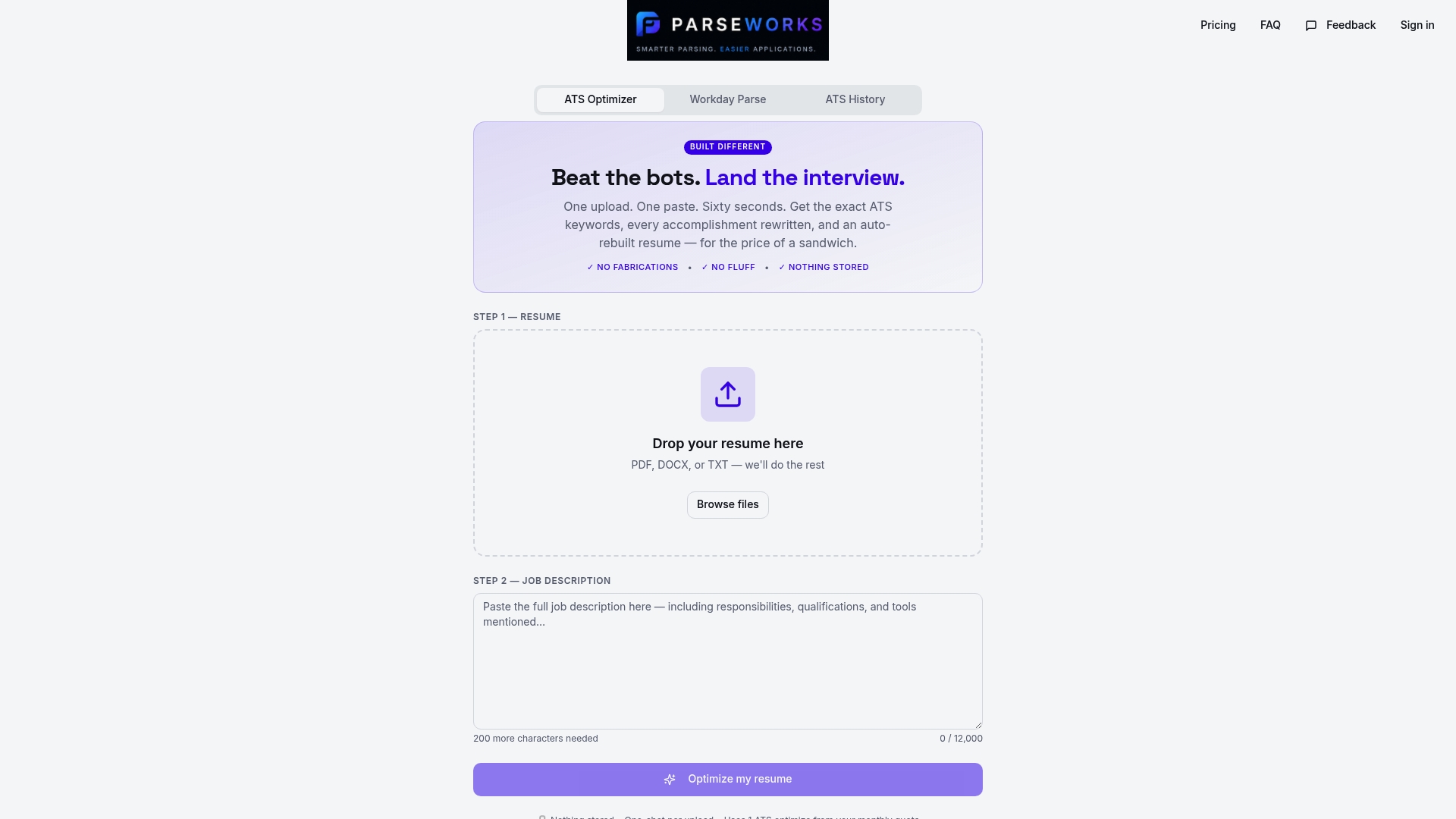
Parseworks gives you a real ATS score against the job description you are targeting, not a generic readability grade. The free ATS resume checker identifies missing keywords, flags formatting issues that block parsing, and shows you exactly where your resume falls short before a recruiter ever sees it. You get rewritten bullet suggestions and a keyword gap report in minutes. If you are applying to roles on Workday, Greenhouse, or Taleo and not checking your keyword match rate first, you are leaving interview callbacks on the table. Run your resume through Parseworks and know where you actually stand.
FAQ
What does keyword optimization mean for a resume?
Keyword optimization means selecting and placing job-specific terms throughout your resume so ATS systems score it as a strong match for a given role. The goal is a 70 to 80% alignment with the job description's core language.
How many times should a keyword appear in a resume?
Each key term should appear two to three times, distributed across your summary, skills section, and work experience. Repeating a term more than three times signals keyword stuffing and can lower your ATS score.
Should I use exact phrases from the job description?
Yes. ATS systems prioritize exact matches over synonyms for critical skills and certifications. If the job description says "content management system," use that phrase rather than "CMS" alone, or include both forms.
Does keyword placement in a resume matter?
Placement matters significantly. Keywords found in work experience, skills, and certifications sections carry more weight with ATS than those in an objective statement or cover letter summary.
How do I know if my resume has the right keywords?
Run your resume against the job description using an ATS checker like the one Parseworks offers. A match rate below 70% typically means your application will not clear the automated filter, regardless of your actual qualifications.