

The resume summary section is a concise, targeted statement placed at the top of your resume, directly after your contact information, that captures your professional value in 1–4 sentences. Also called a professional summary or summary statement, it gives recruiters an instant read on who you are and what you bring to the table. The role of the summary section on a resume is to make a recruiter want to keep reading. Get it right, and it does more work than any other part of your resume. Experts at Indeed, Robert Half, and Sprout all point to the summary as the single highest-leverage section for job seekers with experience or those changing careers.
What is the role of the summary section on a resume?
The summary section is the recruiter's first stop. Before they read a single bullet point under your work history, they scan the top of the page. A strong professional summary tells them your title, your experience level, your top skills, and your biggest win, all in under 60 words.
The goal of the summary is not to convince a recruiter to hire you on the spot. It is to generate enough interest that they read the rest of your resume. Think of it as a movie trailer, not the full film.

The summary also does a job you cannot see: it feeds keywords into Applicant Tracking Systems. Most large employers use ATS platforms to filter resumes before a human ever sees them. A summary packed with the right terms from the job posting increases your chances of clearing that automated screen. Understanding how ATS systems work is the foundation for writing a summary that actually gets read.
Here is what an effective summary accomplishes:
- Signals relevance fast. Recruiters spend seconds on an initial scan. The summary tells them immediately whether you fit the role.
- Replaces the outdated objective statement. Unlike an objective, which focuses on what you want, the professional summary focuses on what you offer the employer.
- Anchors your personal brand. It frames every section that follows. A strong summary makes your experience feel coherent and purposeful.
- Passes ATS filters. Keywords in the summary are parsed early and weighted heavily by most ATS platforms.
"The resume summary is your professional handshake. It should communicate your value proposition clearly and quickly, before a recruiter has read a single line of your work history." — Robert Half career experts
The summary is optional for some candidates, but it is strongly recommended for anyone with significant experience or anyone making a career change. If you have a consistent career theme or transferable skills to highlight, the summary is where you make that case.
How do you write an effective resume summary?
Writing a strong summary follows a clear structure. The order matters, and every word should earn its place.
- Lead with your current title and experience level. Start with your job title and years of experience. If you are a new graduate, lead with your degree and field of study instead. This orients the recruiter immediately.
- Add 3–5 keywords from the job description. Include exact technical skills, certifications, and role-specific terms pulled directly from the posting. Do not paraphrase. ATS systems match phrases, not concepts.
- Quantify at least one achievement. Numbers make claims credible. "Increased sales revenue by 32%" is far stronger than "drove revenue growth." Lead with metrics wherever possible.
- Write in third person, no pronouns. Drop "I," "me," and "my" entirely. The third-person voice reads as more authoritative and professional. "Results-driven marketing manager with 8 years of experience" lands harder than "I am a marketing manager with 8 years of experience."
- Keep it to 1–4 sentences. Anything longer loses the recruiter. Anything shorter may not give enough context. The sweet spot is two to three sentences for most candidates.
- Tailor it for every application. A generic summary is a wasted summary. Swap in job-specific keywords and adjust the focus based on what each employer emphasizes.
- Use strong action verbs. Words like "spearheaded," "delivered," "built," and "led" project confidence. Weak verbs like "helped" or "assisted" undercut your credibility.
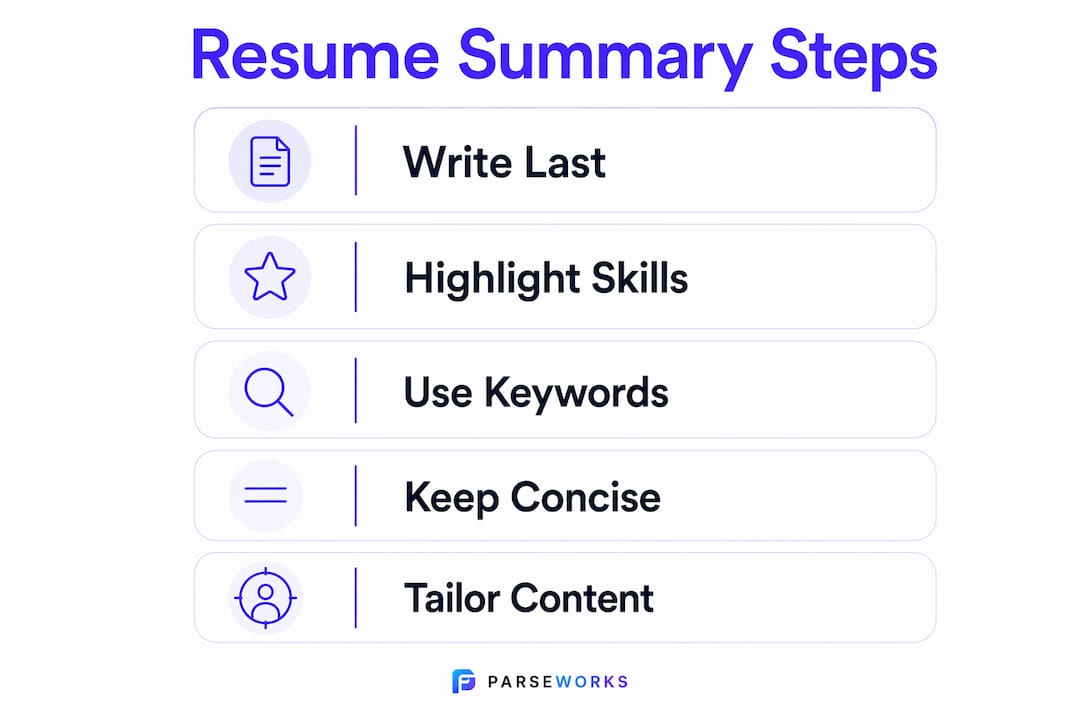
Pro Tip: Write your summary last, after you have finished every other section of your resume. Your work history, skills, and achievements are all on the page at that point. The summary practically writes itself because you are synthesizing what is already there.
Strong vs. weak summary sections: side-by-side examples
The difference between a strong and weak summary is usually specificity. Generic summaries tell recruiters nothing they could not assume. Strong summaries give them a reason to call.
| Experience Level | Weak Summary | Strong Summary |
|---|---|---|
| Entry-level | "Recent graduate looking for a marketing position to grow my skills." | "Marketing graduate with a B.S. in Communications from Ohio State University. Completed two internships managing social media campaigns that grew engagement by 40%. Proficient in HubSpot, Google Analytics, and Canva." |
| Mid-career | "Experienced project manager with good communication skills." | "PMP-certified project manager with 7 years delivering software projects on time and under budget. Led cross-functional teams of up to 15 at Deloitte. Skilled in Agile, Jira, and stakeholder reporting." |
| Senior-level | "Senior executive with leadership experience in multiple industries." | "Chief Operations Officer with 15 years scaling operations for SaaS companies from Series A to IPO. Reduced operational costs by $4.2M at two firms. Expert in OKR frameworks, P&L management, and enterprise risk." |
The patterns are consistent across all three levels. Strong summaries name specific tools, companies, or credentials. They include numbers. They tell you exactly what the candidate does and how well they do it.
Common pitfalls that weaken summaries include:
- Buzzwords without proof. "Passionate team player" and "dynamic self-starter" mean nothing without evidence. Replace them with a specific achievement.
- Summaries that are too long. Five or more sentences turn the summary into a second cover letter. Recruiters stop reading.
- Copying the same summary across every application. A summary written for a product manager role at a startup will not land at a Fortune 500 company. Customize every time.
- Confusing a summary with an objective. An objective states what you want. A summary states what you deliver. In 2026, objectives are largely obsolete for anyone with work experience.
How does the summary section interact with ATS in 2026?
Applicant Tracking Systems parse your resume before a recruiter sees it. They extract text, match it against the job description, and score your fit. The summary section sits at the top of the document, which means it is one of the first blocks of text an ATS reads.
Exact keyword matching is what ATS platforms prioritize. If a job posting says "Salesforce CRM" and your summary says "customer relationship management software," the system may not connect the two. Use the employer's exact phrasing.
Here is what to include in your summary for ATS compatibility:
- Job title from the posting. If the role is "Senior Data Analyst," use that phrase in your summary, not "data professional" or "analytics expert."
- Technical skills and certifications. List them by name: Python, AWS Certified Solutions Architect, Six Sigma Black Belt. Abbreviations and full names both help.
- Industry-specific terminology. Healthcare resumes should include terms like HIPAA compliance or EHR systems. Finance resumes should reference GAAP, FP&A, or SOX. These terms signal domain expertise to both ATS and human reviewers.
- Plain text formatting. Avoid tables, text boxes, or columns in the summary. Many ATS platforms struggle with complex formatting and may skip the content entirely.
Pro Tip: Pull three to five job postings for the same role you are targeting and highlight the skills and terms that appear in all of them. Those are your core ATS keywords. Build your summary around that list, then adjust for each individual application.
Staying current with ATS trends matters in 2026. Platforms like Workday, Greenhouse, and Lever update their parsing logic regularly. A summary that worked two years ago may now miss key signals. Review your summary every time you start a new job search cycle. For a full breakdown of how to optimize your resume for ATS in 2026, the guidance goes well beyond the summary section alone.
Key takeaways
A well-crafted resume summary is the single most efficient way to communicate your professional value to both recruiters and ATS platforms in the first seconds of review.
| Point | Details |
|---|---|
| Position and length | Place the summary directly after contact info; keep it to 1–4 sentences for maximum scannability. |
| ATS keyword matching | Use exact phrases from the job description, including tool names and certifications, to pass automated screening. |
| Quantify achievements | Include at least one metric to make your claims credible and memorable to recruiters. |
| Write it last | Draft the summary after completing your full resume so you can synthesize your strongest points accurately. |
| Tailor every time | A generic summary loses impact; customize keywords and focus for each role you apply to. |
Why most job seekers get the summary wrong
Most candidates write their summary first, which is the wrong order. They sit down with a blank resume and try to summarize a career they have not yet articulated on paper. The result is vague, generic, and forgettable.
The summary should be the last thing you write and the first thing a recruiter reads. That sequence is not a contradiction. It is the whole point. Once your work history, skills, and achievements are fully mapped out, the summary becomes a compression exercise, not a creative one.
The other mistake I see constantly is treating the summary as a place to list personality traits. "Dedicated professional with a passion for excellence" is not a summary. It is a placeholder. Every recruiter has read that sentence ten thousand times. It signals that the candidate has not thought carefully about what they actually offer.
The summaries that get callbacks are specific. They name industries, tools, companies, and numbers. They read like a confident professional talking to a peer, not a job seeker begging for a chance. That tone shift, from supplicant to peer, is what the third-person voice achieves. It is not a grammatical quirk. It is a psychological one.
One more thing: do not let your summary go stale. The job market in 2026 moves fast. Skills that were differentiators two years ago are now table stakes. Review your summary every six months, even when you are not actively searching. The best time to update it is when you just shipped something significant, not when you are already in a rush to apply.
— Sam
Check your summary's ATS score before you apply
Writing a strong summary is one step. Knowing whether it actually works for a specific job posting is another. Parseworks gives you that answer before you hit submit.
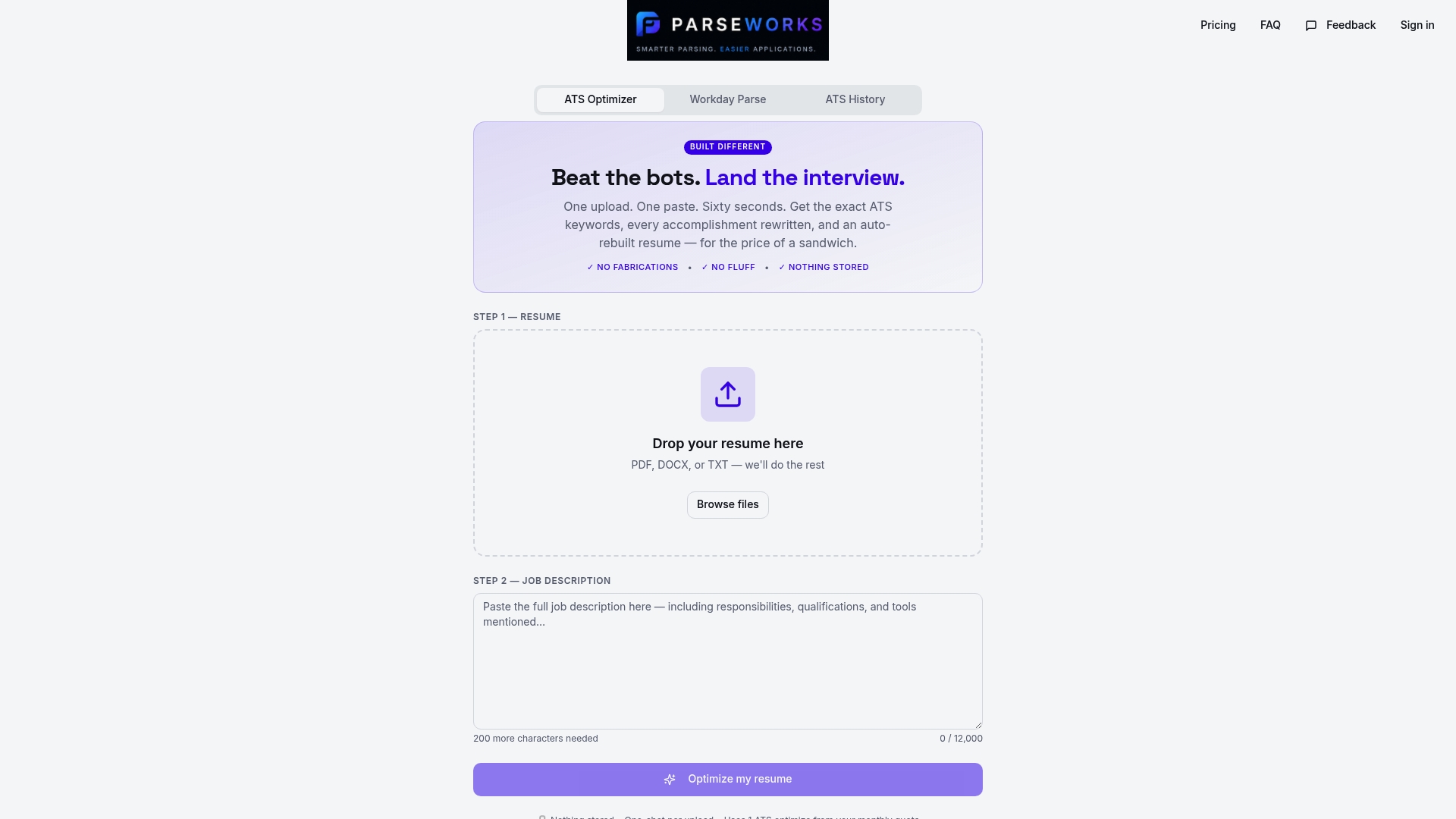
The Parseworks ATS resume checker scores your resume against a real job description, flags missing keywords in your summary and throughout your document, and shows you exactly where to improve. You get specific feedback on keyword gaps, formatting issues, and readability, without retyping your resume into a broken application portal. Whether you are a new graduate or a senior professional, knowing your resume's ATS score before you apply removes one of the biggest unknowns in the job search process.
FAQ
What does a resume summary section do?
The resume summary section gives recruiters a fast, focused snapshot of your professional value. It sits at the top of your resume and signals your title, key skills, and top achievement before a recruiter reads anything else.
How long should a resume summary be?
A resume summary should be 1–4 sentences long. Two to three sentences is the most common length for experienced candidates.
Should entry-level candidates include a summary?
Entry-level candidates can use a summary to highlight their degree, relevant internships, and key skills. It is more effective than an objective statement because it focuses on what you offer, not what you want.
How is a summary different from an objective statement?
A professional summary focuses on the value you bring to the employer, while an objective statement describes what you are looking for. Objective statements are largely outdated for candidates with any work experience.
How do i make my summary ats-friendly?
Use exact keywords and phrases from the job description, including tool names, certifications, and job titles. Avoid synonyms for core terms, since ATS systems match phrases directly rather than interpreting meaning.